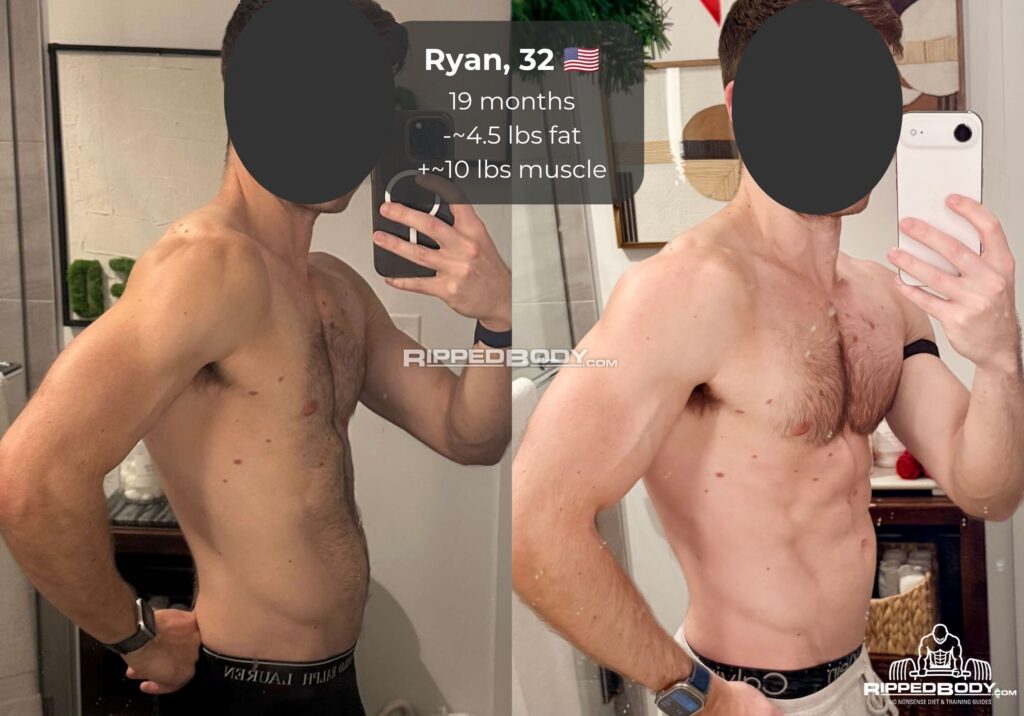
Ryan asked that we use an alias and blur his face. Everything else here is exactly as it happened.
Ryan came to us because a machine told him he was frail.
He’s a 32-year-old accountant in Miami. Financial reporting manager at a public company, which means his year has two speeds: normal, and quarter-end. He’d been strength training on and off for about a decade without much to show for it, and when COVID hit, running took over. He ran two marathons. The lifting went on the back burner and stayed there.
Then he paid for a DEXA scan. It reported that his appendicular lean mass index was far below average, trending toward frail.
That scared him, and the fear is what made him finally reach out.
“I feel that my struggle with gaining muscle has mostly come down to lack of structured programming and accountability.”
Here’s the thing, though. Scans like this are often wrong, and the first thing I did was tell him to ignore it.
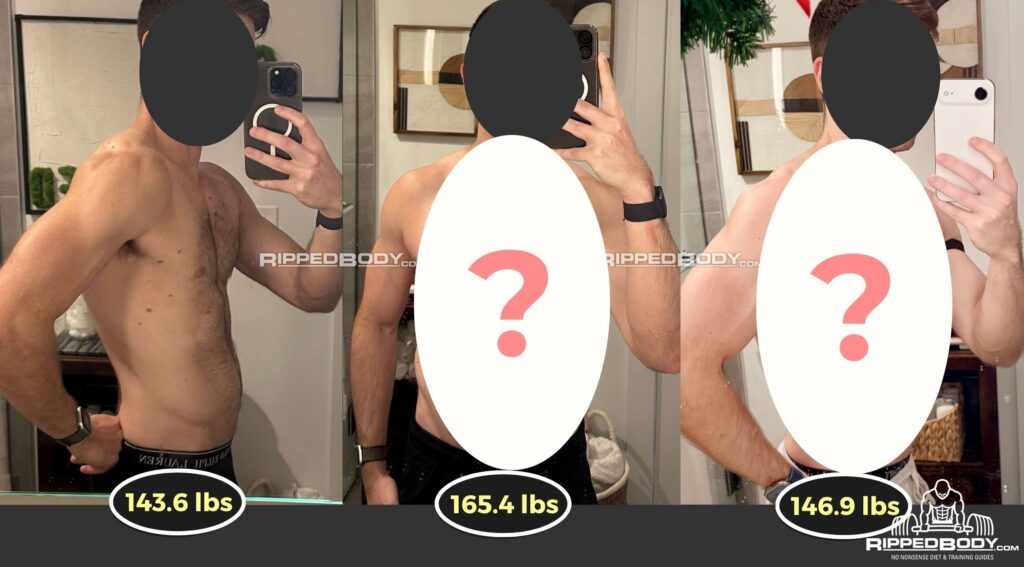
👆 How we started. 143.6 lbs at 5’8″.
The First Coaching Decision Was to Throw Away His Data
I’ll quote what I wrote to him:
All body-fat measurement methods have accuracy and consistency issues. They can be useful when assessing group averages, but this makes them worthless for any individual, who will try to base decisions off of them for adjusting their diet or training, and potentially devastating to motivation.
Ryan was 5’8″, 145 lbs, and somewhere around 14-15% body fat. He was not frail. He was a lean guy who’d lost a little muscle over three years of not training consistently.
This matters more than it might seem. If we’d taken the DEXA number at face value, it would have pointed toward panic: eat everything, train everything, fix the emergency. What he actually needed was a slow, controlled bulk with the patience to see it through.
Right answer, wrong reason. So I told him to promise me he’d never buy another one, and then we started from the measurements that actually work: the scale, a tape measure, and his training log. (Here’s our guide to tracking progress properly.)
Should We Bulk, Cut, or Recomp?
He asked about a recomp. He described himself as “generally skinny-fat” and wanted to do both at once.
👉 He had real training experience, so he wasn’t a rank novice who could grow while losing fat.
👉 He was already fairly lean. The line of his lower obliques was visible. There wasn’t much fat to trade.
👉 Simultaneous fat loss and muscle growth would have been so slow it would be unmeasurable. When results are hard to measure, they’re hard to coach for and hard to stay motivated for.
So we chose one goal: muscle. I told him to expect roughly 2–2.5 lbs of weight gain per month, eight months of bulking, then about four months of cutting to reveal it.
It ended up taking nineteen months. I’ll explain why, because the reason is the most useful part of this whole case study.
Day 1: Lower (back squat, deadlift, Bulgarian split squats, leg extension, calves). Day 2: Upper (bench, cable row, overhead press, chin-ups, arms). Day 3: Lower (leg press, RDL, leg extension, leg curl, calves). Day 4: Upper (dumbbell bench, dumbbell shoulder press, dumbbell rows, lat pulldown, arms).
He’d told me on his application that he could do five days. In week one, he came back and said four felt more realistic.
We went to four. Consistency beats theoretical optimality every time, and a program he’ll actually do for 19 months is worth more than a program he’ll abandon in six. This turned out to be the right call: his training adherence averaged 96% across all 84 weeks.
We deloaded roughly every five weeks (drop one set, reduce the loads by ~10%), and always in response to what he reported about fatigue rather than on a rigid schedule.
Nutrition
Starting targets, with macros cycled higher on training days:
Over the first seven months, I raised his calories four times:
Week
Training day
Rest day
0
2,460 kcal
2,160 kcal
5
2,625 kcal
2,325 kcal
9
2,825 kcal
2,525 kcal
17
2,965 kcal
2,665 kcal
29
3,175 kcal
2,875 kcal
Each one followed the same logic: look back over four to six weeks, find the trend, compare it to the target, and close the gap. (The theory is here: “How To Adjust Calories and Macros as You Bulk.”)
Then I made no changes at all for the next 28 weeks.
That’s over six months of holding a number flat while his progress ran slower than we’d planned. It looks like neglect. It wasn’t. It’s the single most important decision in the bulk, and here’s why.
The Real Problem Was That He Couldn’t Eat Enough
By month seven, the data was clear. We were targeting 2–2.5 lbs of weight gain per month. We were getting about 1.6.
The obvious move is to raise calories again. The obvious move would have been wrong.
He wasn’t hitting the targets he already had. His calorie adherence was running at 85–95% for weeks at a time. Raising a number he wasn’t reaching would only widen the gap between plan and reality, and it would have told me nothing about what his body was actually doing.
Straight talk, from what I wrote to him seven months in:
Your adherence to your workouts is excellent. Adherence to your nutrition targets is what is currently letting you down. You’re coming up consistently short of your nutrition targets by a little over 10%. Even though this is a relatively small amount (300 kcal), as a result, you’re not gaining weight. We can’t grow muscle without the necessary surplus, and your workouts will naturally stall because of it.
Then I asked him the question that actually matters: is this psychological or physiological? Fear of fat gain, or genuine fullness?
His answer was fullness, plus imprecise tracking on the nights he ate out.
The Fix Was a Bowl of Cereal
Not a program change. Not a new supplement. Not a diet philosophy.
I told him to have a small bowl of cereal with milk mixed with whey protein after dinner, before bed. High-calorie, palatable, easy to get down, and worth roughly 300 kcal.
We weren’t after enjoyment at that point. We needed it to serve a purpose.
This is the part of coaching that nobody makes content about, because it isn’t interesting. The gap between where he was and where he needed to be was one bowl of cereal a day, sustained for months. That’s it. That was the whole thing standing between him and muscle growth.
The Twelve-Month Checkpoint
On the anniversary of our start date, I put his numbers side by side.
Weight: 143.6 → 163.5 lbs. Almost exactly 20 lbs.
Stomach up 6–7 cm, arms up ~3 cm, legs up 7 cm, chest and back up 6 cm. Reading that spread, I estimated roughly 10–11 lbs of fat gain and 7–8 lbs of muscle gain.
Now came a real decision: cut, or keep going?
I laid out my reasoning. The longer we bulked, the more muscle he’d have when we cut. A better result at the end would fuel motivation for the next cycle. And he’d told me he could push a little further before feeling uncomfortable.
The only real downside was not being at his leanest for summer.
He raised a fair objection: was he getting to the point where if he continued pushing things, he’d see diminishing returns?
I told him the honest answer, including the part where I used to believe otherwise:
There isn’t a diminishing return in the sense that if we gain too much fat, more of the weight gain will be skewed towards fat. That was a common misconception that I also thought to be true, which seems to have been put to bed. So, really, it comes down to your comfort levels + health risks.
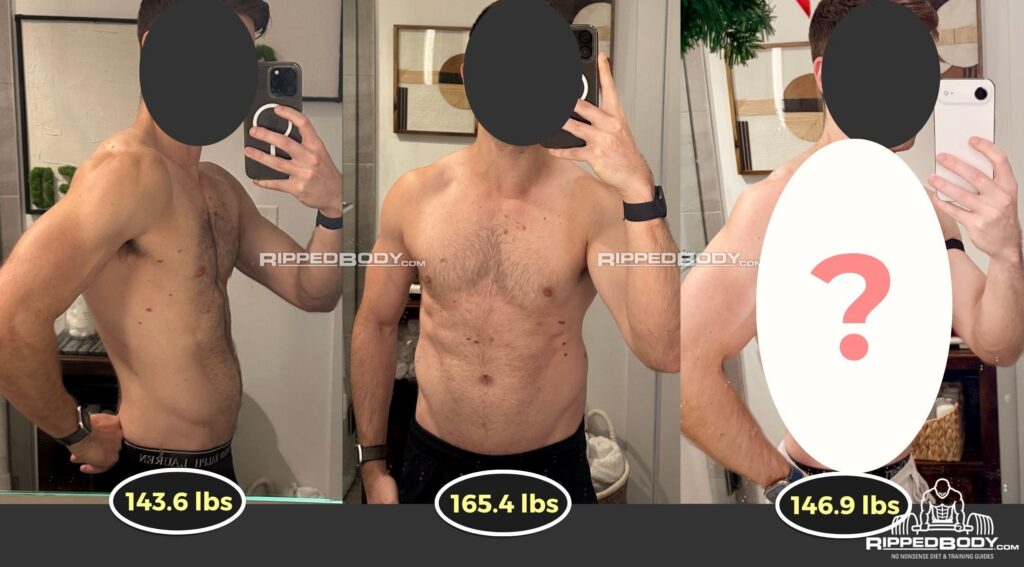
He was easily lean enough that there was no health concern. So we kept going for another five weeks, peaking at 165.4 lbs.
Ultimately, as a coach, I’m the guide, but he’s the boss. He needed my opinion to decide.
🙋🏻♂️ Interested in coaching?Click hereand fill out the form.
The Cut: Six and a Half Months
The Math for the First Drop
This is worth showing in full, because most people guess at it.
Take his average weekly weight gain, add his target fat loss rate, multiply by 500.
👉 He was gaining ~0.4 lbs per week. 👉 We wanted to lose 1 lb per week. 👉 (0.4 + 1) × 500 = 700 kcal
But that number alone makes for a slow start, because energy expenditure has an adaptive component. Metabolism drifts down as you cut, and non-exercise activity has been quietly ramping up during the surplus without you noticing.
A further reduction followed at week 63: 2,110/1,830.
The Best Piece of Data in the Whole 19 Months
By the start of August, we were four weeks into the second reduction of the cut and fat loss was still running slower than I wanted. His weight was down 2.3 lbs over those four weeks, and his stomach measurements had moved between 0.3 and 1.5 cm.
Not nothing. Just less than we were aiming for.
The reflex here is to cut calories again. (Everyone’s reflex is to cut calories again.)
And I could have. His sleep, stress, hunger, and fatigue scores were all sitting at 2s and 3s out of 5, which is to say he had room to give. But before touching a man’s food, there are two things to rule out.
First, adherence. If he isn’t eating what we think he’s eating, then the plan isn’t the problem, and changing it teaches us nothing. His numbers were about 5% over on two of the weeks and 3% under on the third. Accurate enough. Not the problem.
Second, activity. And there it was. His step count had quietly fallen away. Over the previous four weeks it averaged just under 6,000 a day, and the most recent week came in at 3,561.
So I put the steps to him first: could he get back to a consistent daily minimum of 7,000?
He said yes, and then volunteered something useful. He wasn’t feeling sluggish. If anything, his mental sharpness had been better during the cut than it was while gaining. He was happy to take a calorie reduction as well.
So we did both. A 7,000-step daily minimum, and a reduction of roughly 210 kcal a day, bringing him to 1,910 and 1,625.
What Happened Next
Here are the eighteen weeks that followed, set against the ten weeks before:
Weeks 57-66 (before)
Weeks 67-84 (after)
Average daily steps
6,437
9,230
Calorie adherence
98% of target
108% of target
Actual daily intake
~2,070 kcal
~1,930 kcal
Rate of weight loss
2.54 lbs/month
2.81 lbs/month
Look at the second row, because that’s the one that matters.
He ran 8% over his calorie budget for eighteen straight weeks. Work was brutal, he was eating out, and hunger was climbing as he got leaner. He did not hit his numbers.
And he lost fat slightly faster than he had before.
His targets came down by ~210 kcal, but because his adherence drifted the other way at the same time, his actual intake only fell by about 140 kcal a day. Meanwhile his steps went up by nearly 2,800, which at his body weight is worth roughly the same again.
The steps bought him the room to miss his calorie targets for four months and still finish the cut on schedule.
That is the whole argument for tracking more than one variable. If food had been the only lever I could see, I’d have cut him again in August, and again in September when the rate slowed. He’d have been hungrier, more fatigued, training worse, and no leaner for it.
Nobody notices their own step count drifting down by 2,500 a day. That’s why we write it down.
The Time I Refused to Change Anything
In October, deep into the cut and deep into quarter-end at work, he came to me stalling and asked whether we should drop calories.
“I feel like I’m hitting a bit of a mental block, similar to that stage in the bulk where I was stalling out a bit… Not sure if the course of action is just to press on or to move calories a bit lower.”
I said no.
The slowdown was timed with a stressful period at work and a stretch of eating out, not with anything physiological. Cutting his calories at that moment would have added hardship to a week that was already hard, and taught us nothing.
I don’t think we should reduce the calorie intake right now. Let’s see what the next two weeks bring with better adherence and less stress.
Two weeks later his weight had moved again.
Knowing when not to change anything is most of the job. Novelty feels like progress. It usually just destroys your ability to read your own data.
The Results
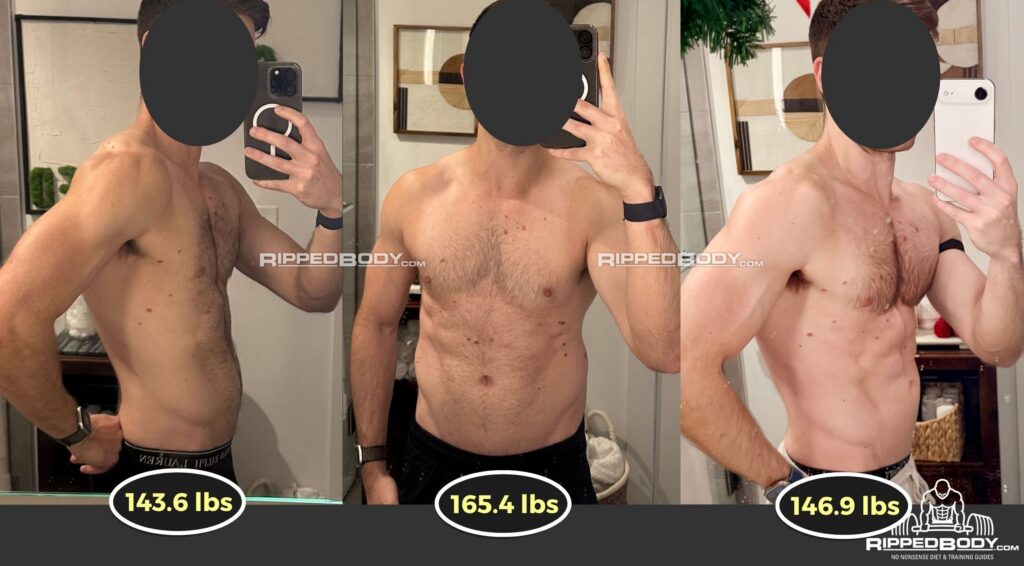
Start (Month 0)
Peak (Month 13)
End (Month 19)
Weight
143.6 lbs
165.4 lbs
146.9 lbs
Chest/back
94.1 cm
99.1 cm
95.2 cm
R arm
34.1 cm
37.0 cm
37.0 cm
R thigh
54.1 cm
60.7 cm
57.0 cm
Stomach (3-site avg)
77.6 cm
84.5 cm
75.6 cm
And the lifts:
👉 Squat: 3×5×155 lbs → 295 lbs for a set of 5 👉 Deadlift: 3×5×155 lbs → 335 lbs for a triple 👉 Bench: 3×10×135 lbs → 205 lbs for a set of 6
He’s ended up 3.3 lbs heavier than he started, and 2–3 cm smaller around the waist. That sounds modest until you work through it.
He is 3.3 lbs heavier and 2–3 cm leaner around the stomach. That difference alone suggests roughly 4–5 lbs of fat loss.
He was depleted at that final measurement. He’d been dieting for months, so he was low on water, gut content, and glycogen. His first measurements were taken in a fed, non-depleted state. When he returns to maintenance, he’ll be 3–5 lbs heavier at the same level of leanness, with higher limb measurements.
Add those together (3.3 + 4.5 + 4), and I estimate ~11.8 lbs of muscle gained. (But let’s consider it 10, to be conservative.)
His arms finished 2.9 cm bigger and his thighs 2.9 cm bigger than where he started, while his waist got smaller. On a 5’8″ frame, that’s a different physique.
“I’m the strongest and most in shape I’ve been at this body weight. I feel like I have the tools needed to continue to make progress with my physique and maintain a healthy lifestyle year round without a ton of added mental stress.”
And when I asked what he’d take away from it:
“To be patient, focus on the data, and just remain steady and focused despite any highs and lows life will throw.”
Four Lessons
👉 The plan took nineteen months instead of twelve, and that’s fine. We didn’t extend it because something went wrong. We extended it because the goal was a total amount of muscle, not a date on a calendar. If you’re short of where you wanted to be, the answer is usually more time, not more intensity.
👉 If you can’t hit the number you have, don’t raise the number. Six months of holding calories flat looked like inaction. It was the only honest option while adherence was the limiting factor. Fix the execution first, then adjust the plan.
👉 Fat loss is not only about food. He spent the last eighteen weeks of his cut running 8% over his calorie target and still lost fat at a good rate, because he’d added nearly 2,800 daily steps. If food is the only lever you can see, you’re coaching with one hand.
👉 Most of the wins were unglamorous. A bowl of cereal before bed. Dropping from five training days to four. Walking more. Not changing things when they were working. Nothing here would make a good reel, and that’s precisely the point. (See: the principles of the Ripped Body Method.)
Ryan trained for 84 weeks through quarter-end crunches, a cruise, a family bereavement, several vacations, and one very demanding job. He was never perfect. He hit 96% of his training sessions anyway.
That’s what this actually takes.
Ryan, thank you for agreeing to share this with the Ripped Body readers. I’m excited to see what you do from here. 💪
👉 If you’re interested in coaching,click hereand fill out the form.
I’ll reach out to see if we’re a good fit. Even if you decide not to work with us, I’ll leave you with detailed advice for your goals.
The Ripped Body® Method is an evidence-based, data-driven approach to physique transformation.
⠀
For most of my 20s, I fell for the fitness industry's scams — the supplements, the fad diets, the noise. This site is what I wish I'd had back then. Since 2011, I've been writing here to help readers skip the years of frustration I went through.
⠀
We've helped 2,000+ busy working men get leaner and stronger without supplements, fad diets, or the process taking over their lives. If you'd like our help, the free course is the place to start — there's a sign-up form on this page, and I'd be honored to show you how.




Privacy policy.