


This is one of our Client Transformation Case Studies series, a deep dive into specific transformations you can see on our Client Results Wall. This case study is written by Coach Matt.
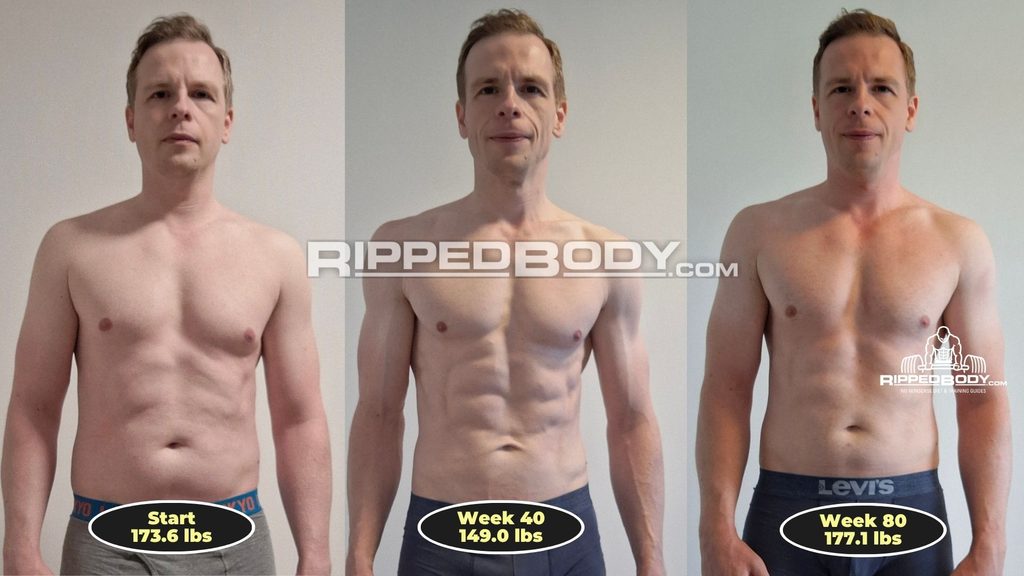
In the two photos below, Thomas’s weight is nearly identical.
And at first glance, it may not look like much has changed. But this represents 18 months of effort through a cutting and bulking phase. Has this effort been wasted? You’d be forgiven for questioning that.
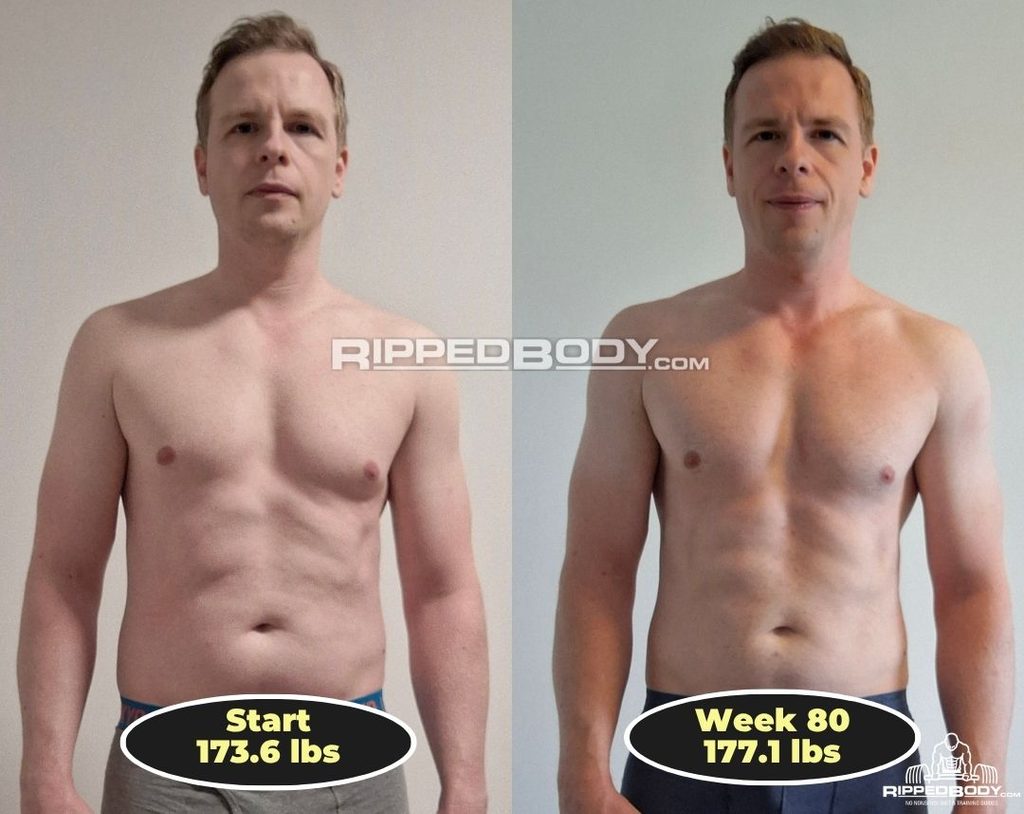
Sure, he looks leaner and more muscled, but there is no denying the changes in the photos are subtle. And that’s the point I want to get across.
This is normal for a cut-and-bulk cycle of an intermediate trainee. Progress won’t always be obvious when bulking, and it can often look like you’re going backward because of the fat regain. This leads many guys to panic and end the bulk too soon, which causes the plateaus we see in coaching applications.
It’s rarely a lack of effort; just a lack of direction.
In this case study, we’ll show you Thomas’s data and how we used it to drive decisions through the cut and bulk. We share the calorie and body measurement changes over these 18 months, and how we use them to estimate total fat loss and muscle gain.
What Brought Thomas Here
When Thomas, a 44-year-old electrical engineer living in Germany, first applied for coaching, he’d been strength training on and off for over 20 years. After building a respectable base of strength and muscle, he spent 3 years attempting to recomp (fat loss and muscle gain at the same time), but he couldn’t get the look he wanted. As he put it, he was “skinny-fat,” landing somewhere between overweight and athletic.
In his coaching application, he said:
“I think I need to change something, to no longer spin my wheels. I’m somewhere between overweight and athletic, skinny-fat, and so far I haven’t been able to find a way out of this.”
Here’s how we’re helping Thomas get in the best shape of his life.
Why We Decided To Cut First
Thomas’s problem wasn’t a lack of knowledge or effort. His problem was a lack of clear direction. I put this down to information overload, reading too much conflicting advice, which left him spinning his wheels.
The recomp wasn’t working. The solution was to pick one direction, either cut or bulk, and commit to it. No second-guessing.
In Thomas’s case, the answer was clear: cut first, then bulk.
Getting leaner would do two things:
- Reveal the muscle that he had already built, providing motivation.
- Allow him to bulk longer before reaching the point where he wants to cut again because of fat regain.
This last point is crucial. Muscle takes time to build, and more time in a surplus means more muscle gained. Too many people end their bulks too early, cut down again, and end up disappointed. Bulking for longer and accepting the fat regain is how you break the cycle.
(Related article: Should I Bulk, Cut, or Recomp?)
Phase 1: The Cut (Weeks 0–40)
His Training Plan
I designed a 4-day, upper-lower split with the equipment Thomas had in his home gym. Similar to our intermediate bodybuilding program, the first two workouts focused on strength, with lower rep ranges and heavier loads, while the final two workouts used higher reps and lower loads.
How We Set Up His Diet
Rather than setting specific targets for all three macros, we set a daily calorie budget of 1770* calories and a protein minimum of 160 grams, targeting 1 pound of fat loss per week.
(Calculate your targets here: Calorie and Macro Calculator)
This was a purposeful, flexible approach aimed at helping adherence. There were no off-limit foods and no strict macro targets to hit, though we did provide “sensible eating” guidelines and asked him to do his best to manage his food environment.
Thomas had work travel and vacations that acted as natural diet breaks. We didn’t rush the process. Going slowly enabled him to get leaner than he had ever managed before.
We only needed to adjust his nutrition targets once, dropping the calories to 1620 when progress slowed.
Here’s how Thomas looked after finishing his cut:
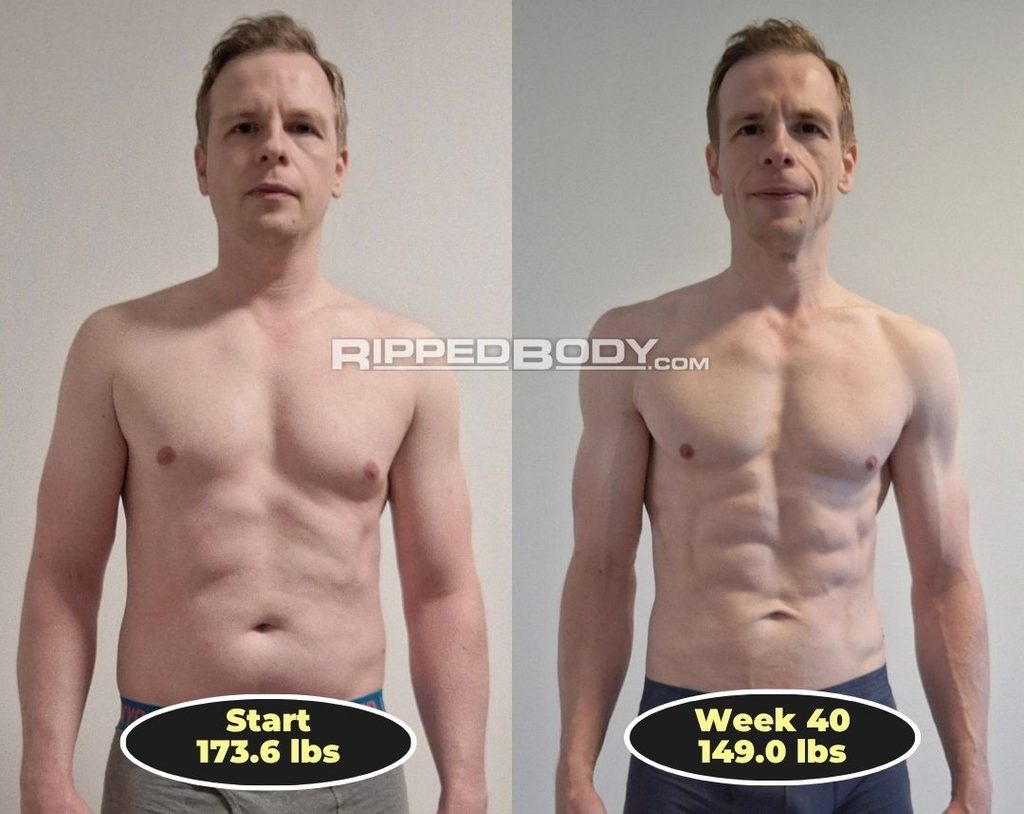
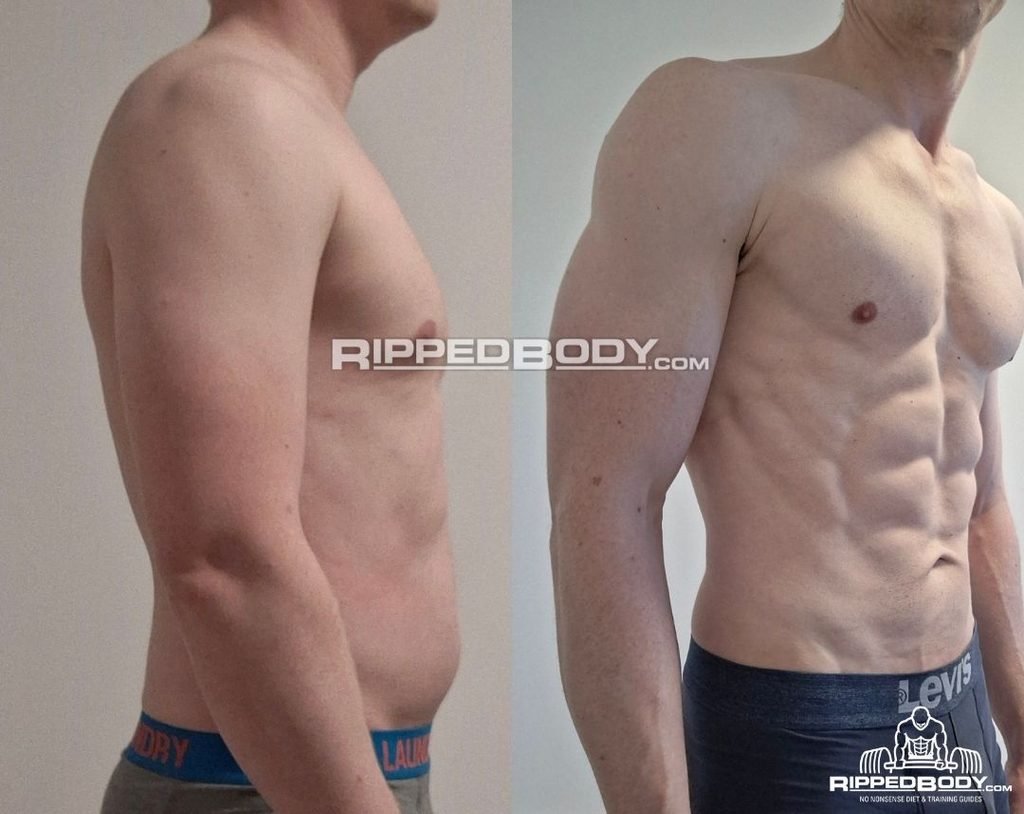
You can see the muscle that he has spent years building. We now have a baseline to build on with the coming bulk.
“Never before in my life have I looked so good! Suddenly there were visible muscles, there were veins on my arms — all the things I’d only ever dreamed of.”
What the Cut Data Shows
Let’s look at what the data tells us about his 40-week cut:
| Week 0 | Week 40 | Change | |
| Weight | 173.6 lbs | 149.0 lbs | -24.6 lbs |
| Chest/Back | 94.5 cm | 94.6 cm | +0.1 cm |
| Right arm | 36.1 cm | 34.4 cm | -1.7 cm |
| Left arm | 35.1 cm | 33.9 cm | -1.2 cm |
| 2″ above navel | 83.8 cm | 72.5 cm | -11.3 cm |
| Navel | 84.1 cm | 70.9 cm | -13.2 cm |
| 2″ below navel | 88.4 cm | 74.9 cm | -13.5 cm |
| Hips | 98.6 cm | 89.3 cm | –9.3 cm |
| Right thigh | 60.5 cm | 54.1 cm | –6.4 cm |
| Left thigh | 60.3 cm | 54.0 cm | –6.3 cm |
- Training adherence stayed at or near 100% for most weeks.
- Calorie adherence consistently landed in the 95–110% range. (This means 5% under to 10% over on average each week.)
- Strength: maintained in some lifts, stronger in others (including the bench press).
In total, Thomas lost 24.6 lbs (11.2 kg). How much of that is fat, muscle, and combined water, gut content, and glycogen (WGG)?
Looking at the measurements, we can see he lost an average of 12.7 cm (5 inches) across the three stomach measurement sites.
Though we tend to obsess over our stomachs, fat is lost from all areas of the body, so it’s not unusual for his limb measurements to be down. However, the fact that his chest/back measurement has been maintained, and that his strength has been maintained or improved, suggests he has gained some muscle mass.
We can check this by using Coach Andy’s heuristic that 2–2.5 cm off the stomach in two or more places is roughly equal to 4–5 lbs of fat loss. Total fat loss is then estimated to be 25.3 lbs. ((12.7 / 2.25) x 4.5)
WGG losses are typically 4–9 lbs. If we take the lower end of that range, muscle gain can be estimated at 4.7 lbs. (25.3 + 4 – 24.6 = 4.7)
This seems generous, so I wouldn’t be surprised if it was more like 3 lbs of muscle, still a good result given his training experience.
*His calorie adherence was on average 5% over as logged, which is excellent. However, even if we do our best to track accurately, calorie intake is often higher than we think. As coaches, we consider this fine as long as tracking is consistent, so we have a baseline to adjust calorie intake and keep the rate of weight loss on target. I say this because people get hung up on specific calorie intake numbers, compare themselves with others who may be able to diet on higher calories, and worry their calorie intake is “too low.” However, if you are losing weight at your target rate, training is going well (supporting muscle maintenance), and hunger and fatigue are manageable, then your calorie intake is not too low. Don’t let people convince you otherwise.
Phase 2: The Bulk (Weeks 40–80)
How We Set His Gaining Rate
With the cut out of the way, we turned our sights toward muscle gain. This is always a much slower process than fat loss.
At his level of training experience (intermediate trainee, relative to his likely genetic potential), we estimated that he could gain 0.5–0.75% of his body weight as muscle per month. Knowing that even in the best-case scenario, half of the weight gain is likely to be fat, we set his target weight gain at double that, 1.25%, which is roughly 2 lbs (0.9 kg) per month.
(See where we get these numbers from: How To Bulk Without Getting Fat)
Moving From Cutting to Bulking
To transition from cutting to bulking, we typically have clients eat at maintenance for two weeks first, rather than bumping calories all at once, as clients have reported less digestive discomfort when doing this. First, I’ll explain the simple math, then I’ll run you through how we applied this to Thomas.
Calculations to Transition from a Cut to a Bulk
(From: How To Bulk After Cutting)
- Step 1: To find approximate maintenance, multiply your average weekly weight loss (in pounds) by 500, add that to your current daily calorie intake, and add your weight (in pounds).
- Step 2: To gain 1 pound of weight per month, add 150 kcal each day. (330 kcal for 1 kg)
- Step 3: Adjust every 4–6 weeks as necessary to stay on track.
Thomas was losing 0.7 lbs per week on average, so we increased his calorie intake by 500 kcal, raising his daily calorie target from 1620 to 2120 ((0.7 x 500) + 1620 + 149), while protein stayed the same at 160 grams.
As protein needs are lower when bulking, we could have reduced his protein intake, but he was happy and in the habit of eating that much, so we kept it as is.
To move into the bulk, we bumped calories by 180 (rather than the full 300), bringing him to 2300 kcal. This is a little more conservative than what we typically recommend, but it was at Thomas’s request, as the initial bump in weight from water, gut content, and glycogen worried him. As there are no downsides to being conservative, we agreed.
Within a few weeks, we had to increase his calorie intake again to reach the calorie surplus needed to hit our target of 2 lbs.
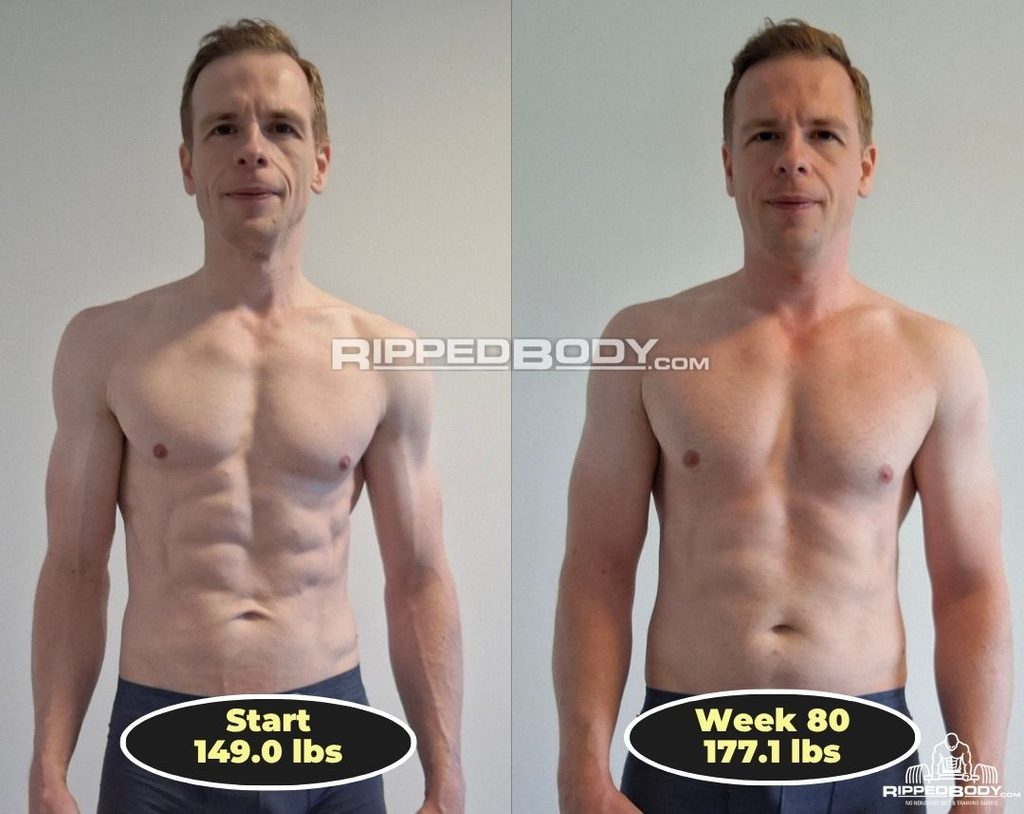
Over the next 40 weeks (we’re still bulking at the time of writing), he gained 28.1 lbs. We increased his intake as needed to keep gaining weight at our target rate. This is how his calorie intake has changed throughout his bulk so far: 2300 kcal → 2450 kcal → 2600 kcal → 2800 kcal
What the Bulk Data Shows
Let’s take another look at the first comparison photo.
It may look like he’s carrying a similar amount of fat in both, but the difference in the chest/back size and stomach is clear when you look at Thomas’s data, and we can use this to estimate how much muscle we have gained so far.
| Week 0 | Week 40 | Week 80 | Change (from start to 80) | |
| Weight | 173.6 lbs | 149.0 lbs | 177.1 lbs | +3.5 lbs |
| Chest/Back | 94.5 cm | 94.6 cm | 99.5 cm | +5.0 cm |
| Right arm | 36.1 cm | 34.4 cm | 36.6 cm | +0.5 cm |
| Left arm | 35.1 cm | 33.9 cm | 36.5 cm | +1.4 cm |
| 2″ above navel | 83.8 cm | 72.5 cm | 80.4 cm | -3.4 cm |
| Navel | 84.1 cm | 70.9 cm | 78.0 cm | -6.1 cm |
| 2″ below navel | 88.4 cm | 74.9 cm | 81.9 cm | -6.5 cm |
| Hips | 98.6 cm | 89.3 cm | 96.0 cm | -2.6 cm |
| Right thigh | 60.5 cm | 54.1 cm | 58.8 cm | -1.7 cm |
| Left thigh | 60.3 cm | 54.0 cm | 58.6 cm | -1.7 cm |
- He’s now 3.5 pounds heavier.
- His stomach measurements are down by 5.3 cm on average. Using the heuristic introduced earlier, this suggests he is roughly 10.7 lbs leaner. ((5.3 / 2.25) x 4.5)
- This means we have 14.2 lbs (10.7 + 3.5) to explain, some of which will be water, gut content, and glycogen.
If we assume 6 lbs of WGG, this estimates 8.2 pounds of muscle gain. Is this reasonable?
- Well, we estimate he gained a few pounds of muscle when cutting, and he has now been bulking for 9 months.
- His legs are not quite as large, but he carried a good amount of fat there, so this isn’t surprising.
- His chest and back have grown 5 cm, and his arms are bigger.
So, yes, I’d say it’s a reasonable estimate. We’ll gain a few more pounds as we finish the bulk, and I’m excited to help him cut and reveal it all.
The Important Lesson
If Thomas had only used the scale and the mirror to judge his progress, as many do, he’d be forgiven for questioning the process and bailing partway through. However, because we had progress photos and body measurements, we were able to use this data to drive decisions.
Your eyes can deceive you, but the data doesn’t lie.
Here’s what Thomas said:
“I weighed 79 kg in January, and now, 18 months later, I weigh 79 kg again — oh God, so I’ve achieved nothing?! Was it all for nothing? Oh yes, there was — just look at the photos and body measurements! The 79 kg back then has nothing to do with the 79 kg I am today, but you can’t see that from the weight alone.”
Three Key Takeaways
👉 Trust the data, not your eyes. If you saw Thomas’s before photo next to his final bulking photo, it would be easy to assume not much has changed. Make sure you track body measurements and lifting data.
👉 The scale only tells part of the story. Make sure you take body measurements, so you can estimate muscle and fat mass changes.
👉 To escape the skinny-fat trap, you need to alternate cutting and bulking phases. Keeping your weight stable and aiming for body recomposition sounds more efficient, but unless you’re a beginner, detrained, or using anabolic steroids, it probably won’t work very well. Feel free to try it, but when it stops working, choose one direction or the other.
Thomas, thank you for being willing to share your data and your story.
If you’d like to have us in your corner, you can get started at rippedbody.com/coaching.
Thank you for reading!

Privacy policy.