


Updated: 28th December, 2025
This article is adapted from the content in the 3rd edition of our book, The Muscle and Strength Pyramid: Training. This article will show you how to systematically assess and address training plateaus.
The training plateau trap people get into is usually this:
- Start training seriously. 👉 Progress linearly and consistently by adding weight each session. 👉 Stall.
- Train a little harder. 👉 Progress for a while. 👉 Stall.
- Keep adding weight anyway. 👉 Form degrades over time… *snap* 👉 injury.
Frustration. Loss of motivation. 1–3 months break from the gym entirely (instead of working around it and training what you can). - Restart training with more attention paid to good form. 👉 Progress up to and possibly past the previous plateau. 👉 Stall.
- Google “how to progress” and come across something like our Hypertrophy Progression System. 👉 Progress for a while, then stall.
- More Google. 👉 Come across a bunch of stuff that won’t move the needle: Drop sets, giant sets, supersets, a new training program, bro splits, more, more, MOAAAR! 👉 Stall.
Sound familiar? Let’s fix that!
What To Do When You Plateau
The first step is determining whether you’re actually plateaued, which starts with realistic expectations for progression based on your training status, as shown in the table below.
| TRAINING STATUS DEFINITION AND ESTIMATED AVERAGE RATES OF PROGRESS | |
|---|---|
| Novice | Able to add load and/or reps each time a lift is repeated in the same week or from week to week. This phase can last for years but may be as short as 6 months with consistent, progressive training, sufficient recovery, and effort. |
| Intermediate | Progress slows. You might add reps in the 10–20 rep range week to week, or add load in lower rep ranges month to month. With appropriate training, most reach this stage by year 1 and may remain here through years 4–5. Many never progress past it. |
| Advanced | Gains are much slower. You may add a rep or two in the 10–20 rep range month to month, or make small increases in reps or load in lower rep ranges over longer timeframes. Progress becomes increasingly difficult as you approach your muscular potential. Most lifters never reach this phase. |
If your strength is no longer progressing at a rate appropriate for your training age, it’s time to troubleshoot.
The flowchart will help you determine whether the issue is:
- Training-related — such as insufficient volume, poor exercise selection, or inadequate overload.
- Recovery-related — such as low sleep quality, poor nutrition, or excess life stress.
- Technical or psychological — like poor movement execution or life stress.
Assessing and Responding To Plateaus Flowchart
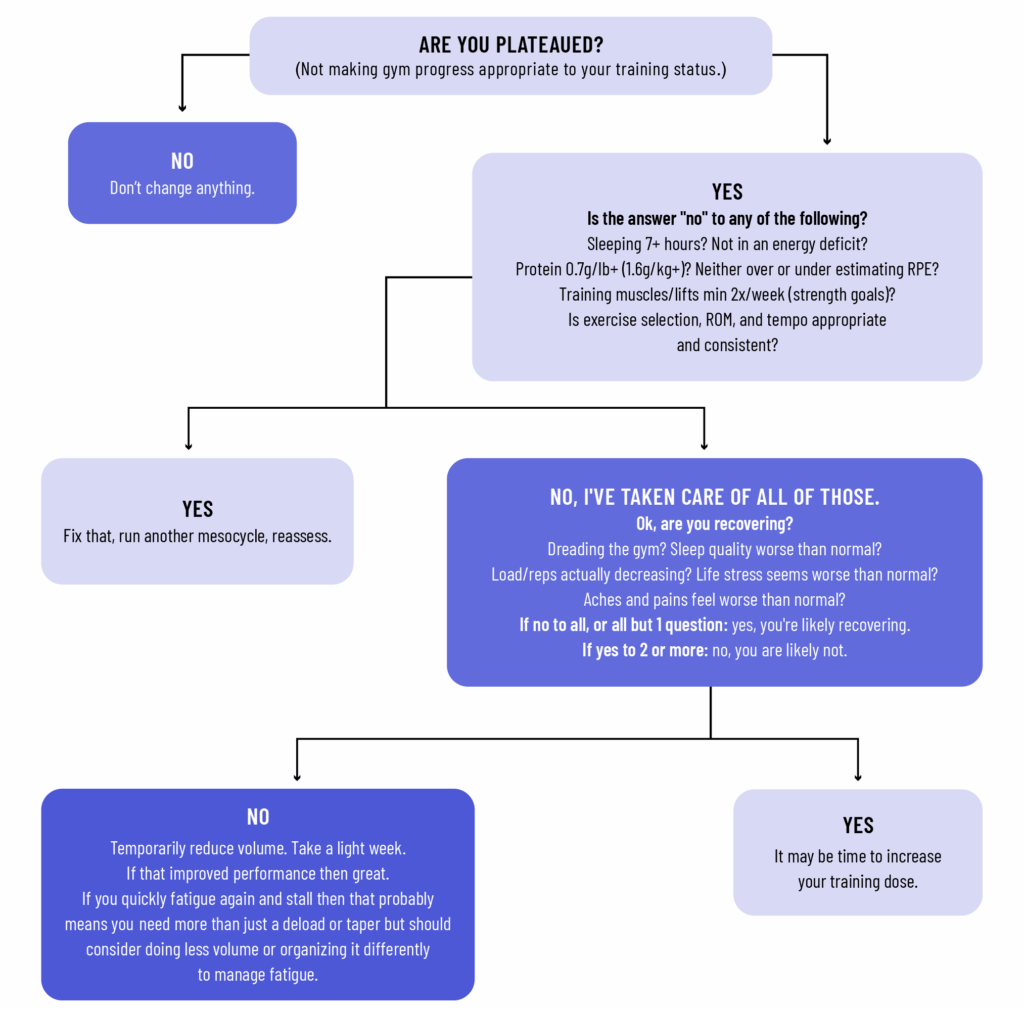
1) You’re not sleeping enough. If you aren’t sleeping 7+ hours, as hard as it may be to do so, that might be your issue. Yes, you may be waving your hands in the air right now, “Impossible, I have kids!” Ok, I get it, but that doesn’t change this fact. Try to sleep more. If you’re sleeping just 6 hours, then aim for 7 and see how you do.
2) You’re not eating enough. You can’t expect your body to make something from nothing. The leaner you are and the more training experience you have, the harder it is to make progress when your weight is stable or decreasing (aka when you are at caloric maintenance or below).
On average, for a guy that is say, dieting (aka. cutting) from 20% body fat to a stage shredded 5% (add 8% to these figures for women), they’ll make progress during the first 1/3 of the cut, work to maintain their progress during the middle third, and then probably regress a little in the last third.
Most people reading this won’t be competing, but many of you will be looking to get down to that 9-12% body-fat range at some point, which, for guys, is when your abs are nicely through. What this means is that your progress will likely stall at some point while you are cutting, regardless of what you do. Fighting this can get you injured.
3) You’re not eating enough protein. If you aren’t consuming at least 0.7 g/lb (1.6 g/kg) per pound of body weight, doing so may help. However, this doesn’t mean eating sufficient protein negates the importance of the previous point. (See our protein intake guidelines.)
4) You’re training too hard or not hard enough. Overestimating RPE means not training hard enough (close enough to failure). This is exceptionally common. Underestimating RPE means you are training too close to failure, too often, which leads to greater fatigue than is desirable and hampers your progress. This is less common. (See our RPE & RIR guidelines.)
5) You’re not training each body part/lift frequently enough. Are you hitting each muscle group (if you’re a bodybuilder) or lift (if you’re a powerlifter) at least twice a week? If not, consider adjusting your program to do that. Here are our sample programs:
6) Your lifting technique is poor. Are you training with good form, or using such poor form that you’re cheating yourself out of progress? I’m not talking about people who swing their bicep curls, kip their pull-ups, or perform rows with the momentum of their whole body — such mistakes should be obvious and are present in every gym I’ve ever set foot in. I’m talking about people who are trying to be conscious of their form but aren’t quite getting it right.
If you have a trainer you can trust or a friend who knows their stuff, have them take a look. Otherwise, consider checking out The Lifting Library, by my co-author Eric and his coaching team.
For the squat, bench press, and deadlift specifically, here are three free mega-guides created by my team and me in Japan:
- 🏋🏻♂️ How To Low Bar Squat: The Definitive Form Guide
- 🏋🏽♂️ How To Bench Press: The Definitive Form Guide
- 🏋🏿♂️ How To Deadlift Properly: The Definitive Form Guide
7) You have joint/tendon pain. If you only say yes to having joint/tendon pain, you can probably do a “normal” training week in terms of volume and RPE, but just up the reps to 12–20 on exercises that cause pain. If that’s not enough to be pain-free, you could even lower the weight more and use blood flow restriction (BFR) — more on this in a second — for limb training.
BFR training is an interesting method of training used primarily in clinical settings, whereby a blood pressure cuff, bandage, wide tourniquet, or even knee wraps are applied at the proximal limb (upper thigh or armpit) during training so that venous blood flow out of a muscle is restricted, while arterial blood flow into the muscle is maintained. This prevents metabolites from clearing, resulting in earlier fatigue of muscle fibers, and subsequent recruitment of high-threshold motor units and their associated fibers at training loads as low as 20–30% of 1RM.
While BFR isn’t more effective than traditional training, it can be equally effective for hypertrophy (though not for strength). BFR can be especially useful when experiencing joint pain in the knees or elbows, as you can maintain a muscular stimulus, with a load much lower than normal, which may facilitate joint recovery.
So if you do happen to answer “yes” to the specific question related to aches and pains due to elbow or knee discomfort, you can swap out limb training exercises for BFR versions where you use a knee wrap (or flexible bandage, or even a specialized wrap sold for BFR specifically) wrapped to a 7 out of 10 tightness — firm but not restrictive to the point of tingling or discoloration (purplish). If you notice either, loosen the wrap.
Then, perform your normally programmed number of sets using 20–30% of 1RM, taken to 0–3 RIR. This can be an effective way to keep progressing while staying pain-free.
Changing Training Volume
If you’ve dialed in your nutrition, sleep, stress, training organization (i.e., how training stress is distributed across sessions), and RPE/RIR accuracy, yet you’re still not recovering even after a deload, then volume is likely too high.
You may be doing too much, such that only a microcycle or two puts you in the hole, requiring a deload, which is an inefficient ratio of stress to recovery. In this case, you need to simply do less. A decent place to start for a volume reduction is reducing sets by ~20% across the board. So if you were doing 15 sets for a muscle group or movement, you’d go down to 12. Then, see if you can progress more consistently without having to constantly address overreaching.
On the other hand, you might need to do the opposite. However, very frequently, volume is not the issue; rather, a technical issue is preventing you from getting stronger or bigger. You may be:
- Misjudging RIR.
- Using poor form or suboptimal exercise selection, failing to target the intended muscle effectively.
- Lifting with inconsistent tempo or range of motion.
If there are no technical issues and other potential bottlenecks are not causing the plateau (sleep, nutrition, life stress, training organization), you’re feeling recovered, and you have the time and energy to do so, a ~20% increase in volume is a reasonable and research-supported guideline likely to result in additional progress.
This increase can be global, across all muscle groups or lifts if you’re plateaued on all lifts, or targeted if only specific movements are stalling. Finally, when increasing volume, consider adjusting your frequency to distribute the added workload better. For example, adding an extra training day can help prevent any single session from becoming too demanding.

If you have found this helpful, you might be pleased to know it is just a small section adapted from our Muscle and Strength Pyramid books.
Join 200,000 other readers, get your copies here.

Privacy policy.