


If you’re currently cutting, or you’re thinking about starting a cut, there’s a good chance you’ve tried and failed before.
This wasn’t because you’re lazy. And not because your program was wrong.
You struggled because nobody told you that sustaining a calorie deficit is a skill. And like any skill, if you don’t know the rules, you’re going to make it harder than it needs to be.
I’ve watched this pattern play out hundreds of times. Smart, disciplined guys who grind through two to three months of misery, but then snap and rebound. They then wonder why cutting never seems to work for them.
The problem is that they made it needlessly brutal.
And if that resonates, this article will help you fix that.
1. THE MINIMUM VIABLE CALORIE DEFICIT
The first thing most people get wrong is the size of their deficit. How fast they try to lose weight.
Faster is not always better.
I understand the logic. You want to get this over with. You’ve got a beach holiday, a reunion, a deadline. So you slash calories, push through the hunger, and tell yourself it’ll be worth it.
But you’ve tried this, and it wasn’t, was it?
When you get too aggressive:
Your hunger becomes unmanageable. Your training performance drops. Your body starts breaking down muscle for energy. And eventually, you snap. Not because you’re weak, but because you’ve made the process unsustainable.
We all know habits matter.
So stop practising habits you can’t sustain.
There’s no point in replacing the habits that aren’t leading to your goal, for a set of behaviors that are so hard to sustain they can’t become habits.
You’re not a bride looking to squeeze into her wedding dress. You’re looking to consistently improve your physique over time.
In our experience, the sweet spot for fat loss is roughly 0.5 to 0.75% of your bodyweight per week. For most men, that lands somewhere between three-quarters and 1.25 lbs of fat loss per week. Push any higher than this, and you risk muscle loss as well.
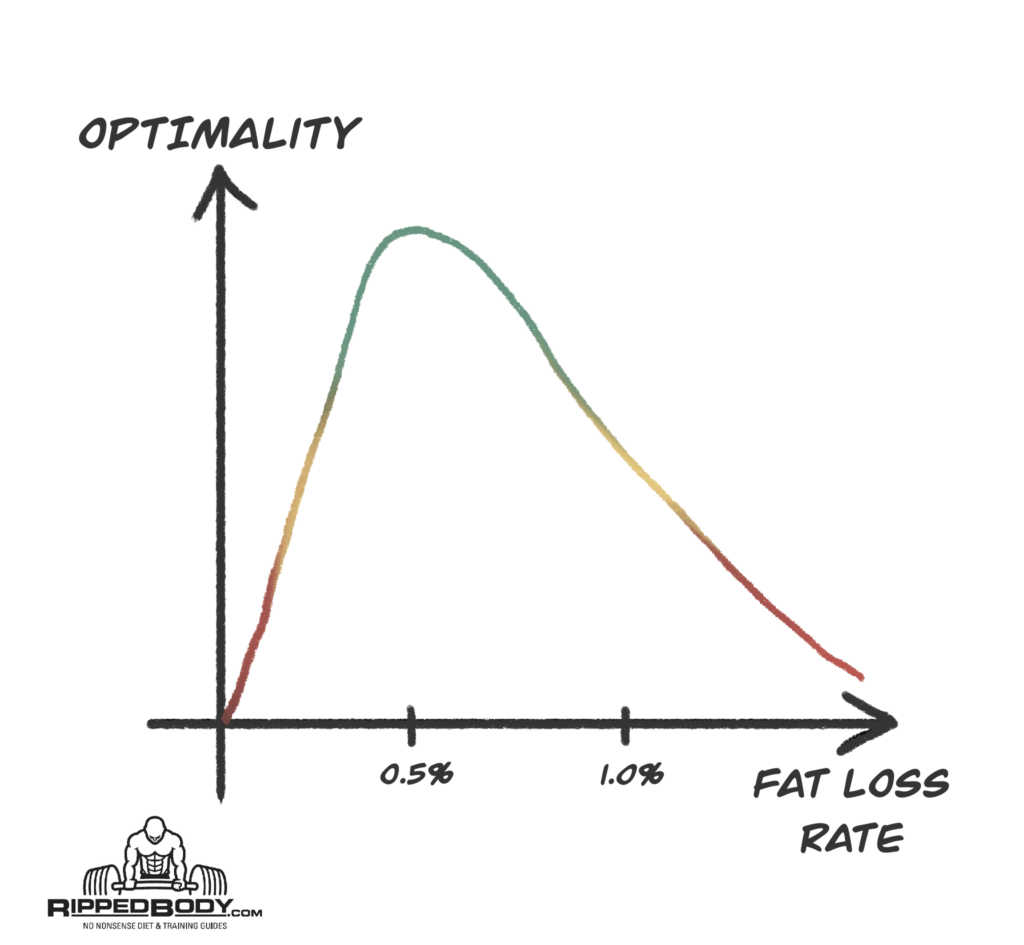
Now I know that sounds slow, but the purpose is to preserve muscle, performance, and enough sanity to stay consistent for long enough to make a real and lasting difference.
Here’s a client of ours, Dave.
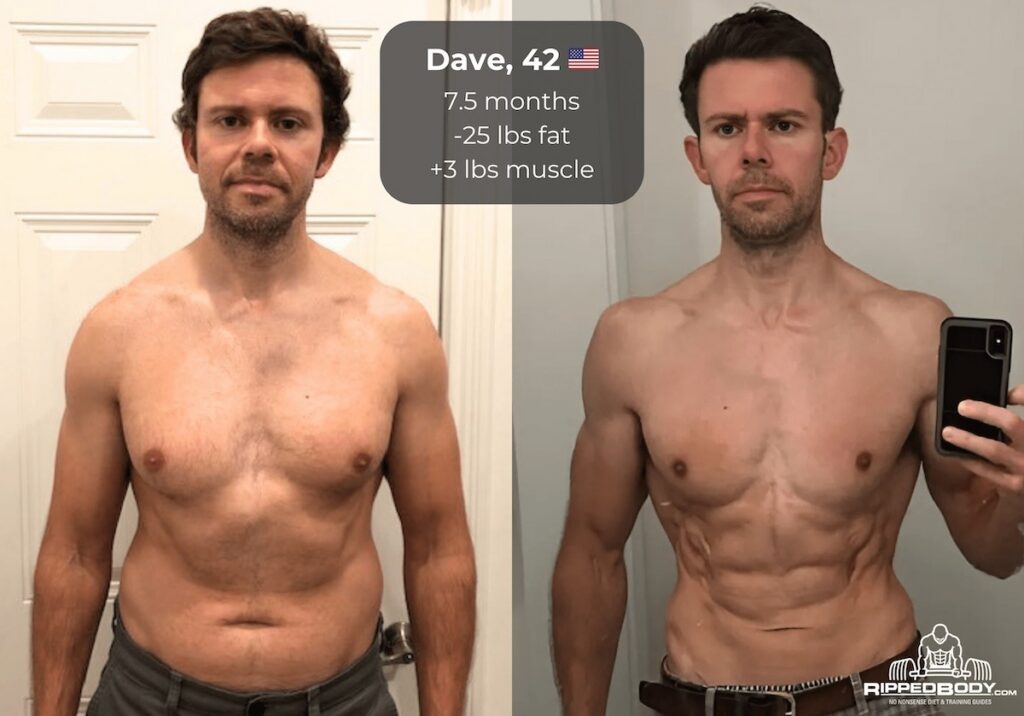
We had a modest weekly deficit, which helped him adhere, and the result was 25 lbs of fat loss in seven and a half months.
This is something he had been trying to achieve for years. And that summer was his first family holiday where he didn’t feel self-conscious taking his kids to the beach.
Here’s another client, John.
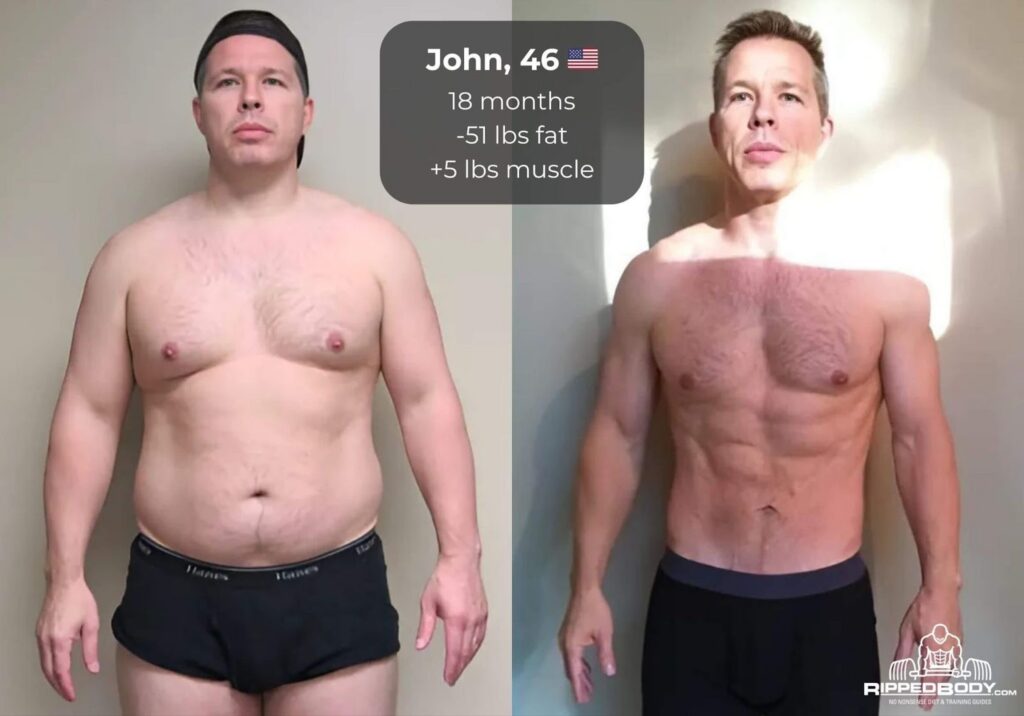
For years, John was stuck in a cycle of aggressive deficits and complete rebounds. We broke free by setting modest and sustainable targets. That way, his efforts could compound, instead of constantly being interrupted. And 18 months later, 51 lbs lighter, I’m sure you’ll agree, he looks like a new man.
The key is to give yourself the minimum calorie deficit that still produces measurable and meaningful fat loss week over week. Not the maximum you can white-knuckle your way through.
But did you notice that it took them longer to achieve the level of fat loss than our target rates would have calculated?
This is because we used Diet Breaks. Which I’ll come back to at the end. But first, there’s something even more important.
2. SENSIBLE FOOD CHOICES
Two people can eat the same number of calories and have completely different experiences of hunger. Part of that is genetic, and part is food choices. We can’t change our genetics, so let’s focus on our food choices.
One person eats ultra-processed food for lunch and is ravenous by mid-afternoon. The other eats whole foods and feels fine through to dinner.
Same calories. Very different experience of a calorie deficit.
The reason is satiety: how full you feel after a meal. And when you are trying to sustain a calorie deficit, how full you feel per calorie matters.
There are two levers to pull here: protein intake and low-calorie-density foods.
Protein is the most satiating macronutrient. It also requires the most energy to digest, and it helps protect against muscle loss. After calories, getting your protein right is the most helpful thing you can do during a cut.
If you have a good idea of your body fat percentage, then:
- When cutting, aim for 1.14 g per pound of lean mass (2.5 g per kg)
Now, as I’ve already mentioned in my video on progress tracking, it’s exceptionally difficult to get an accurate estimate of body fat percentage. So, you might consider this recommendation instead:
- When cutting, 1 g per pound (2.2 g/kg) of target body weight.
Beyond protein, choose low-calorie-density, high-volume, and high-fibre foods. Non-starchy vegetables, fruits, soups, and low-fat dairy. These take up physical space in your stomach and slow digestion. You feel fuller for longer, and hunger becomes manageable rather than a constant distraction.
Consider these two meals:
- A high-volume meal: grilled chicken, a large portion of leafy greens, low-fat salad dressing, and some potatoes. This is around 700 calories, and very filling.
- A latte and a protein bar.
Which one is likely to keep you full until dinner? The answer is obvious, but most people don’t think about it and assume their caloric deficit is the problem, without thinking about their food choices.
During a cut, you’re working with a limited calorie budget. Spend it on food that works for you, not against you.
3. YOUR FOOD ENVIRONMENT
Here’s the uncomfortable one. Willpower is finite. Everyone knows this, but almost no one acts on it.
If there are bags of chips and snacks in your cupboards, you will eventually eat them. Not because you have no discipline, but because you’re a normal human being with a brain wired to seek out high-calorie food when hungry. The solution isn’t to try harder. It’s to engineer the situation so trying hard isn’t necessary.
We call this food environment design, and it’s one of the highest-leverage things you can do during a cut.
- Remove the snackfoods from your house. If you can’t because you’ve got kids, hide them in cupboards in opaque containers. Out of sight, out of mind.
- Put the right foods in easy-to-find places. Fruit in a bowl on the kitchen counter that you’ll have to walk past to get to the hidden snack foods is a great idea.
- Shop in advance, so you have what you need.
- Cook in advance when you know you’ll be busy.
- Don’t shop when hungry.
Half of your success happens at the grocery store. If you set your environment up right at the start of the week, most of the decisions are already made for you.
4. DIET BREAKS
Every client takes diet breaks. If a coaching applicant refuses this idea after we’ve explained why they’ll be a part of the process, we politely decline to work with them.
That’s how strongly I feel about this.
A diet break is a planned, deliberate return to maintenance calories, typically for one to two weeks, inserted into a longer cut. You can think of it as nutrition periodization.
The goal is to avoid the dreaded starve, binge, screw-it cycle:
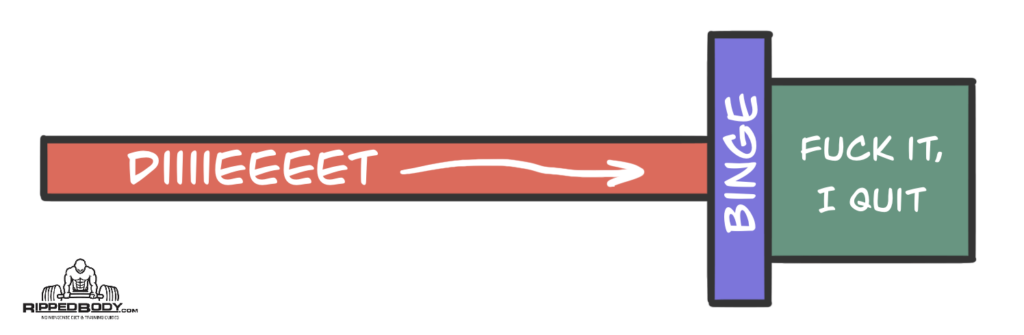
After you’ve been dieting for a while, a few things happen. Your hunger increases. Your metabolic rate drops. Your energy levels drop. Your training performance suffers. And you get moody.
A diet break interrupts that. It interrupts the monotony, and critically, it helps you come back to dieting feeling fresh, motivated, and ready to continue crushing it.
We typically recommend a diet break every 10 to 14 weeks. Time them with your family vacations, or whenever you see two or more of these stacking up at the same time.
- Persistent low energy.
- Consistently poor sleep.
- Gym performance is declining across your main lifts.
- And hunger that doesn’t respond to sensible food choices.
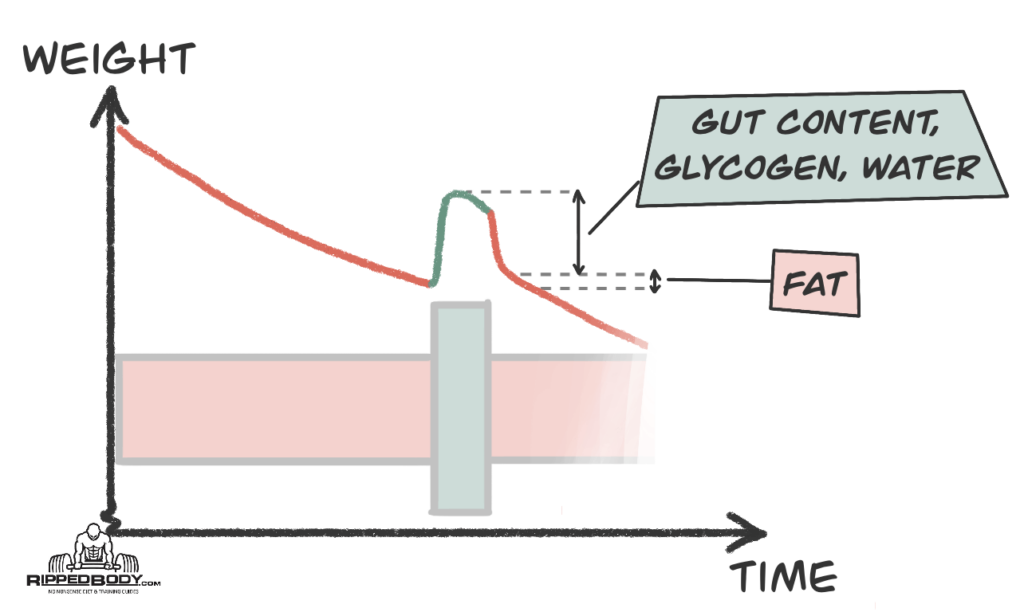
Just know that you will experience a bump in your weight due to water, gut content, and glycogen, but this will come whooshing off the week after you return to dieting.
I understand the urge to skip diet breaks, but taking them is not a weakness; they are tools built into a well-designed cut.
Use them, and you will almost certainly reach your goal faster and easier than if you try pushing straight through.
PUTTING IT TOGETHER
Let’s compare what most people do, vs what actually works.
Most people: aggressive deficit, no structure around food choices, an environment full of temptation, and no diet breaks.
Our clients: modest deficit, protein and food volume prioritised, food environment sorted before day one, and diet breaks planned in advance and available as a tool to pull out when needed.
The second approach is not softer or less serious. It’s smarter.
You are human. Treat yourself like one, and you’ll be successful.
Because here’s the thing nobody in the fitness industry wants to say out loud: getting lean is not the hardest part. Staying lean is.
But if your cut was achieved through white-knuckled it to the end, you’re almost certain to rebound.
Do it right, and you’ll keep what you worked for.
What do you think? Can you relate to any of this? Tell me your experience in the comments.
If this helped, enter your email address in the box below to get our free 15-day Transformation Kickstart Bundle.
Thank you for reading!

Privacy policy.