


This is one of our Client Transformation Case Studies series, a deep dive into specific transformations you can see on our Client Results Wall.
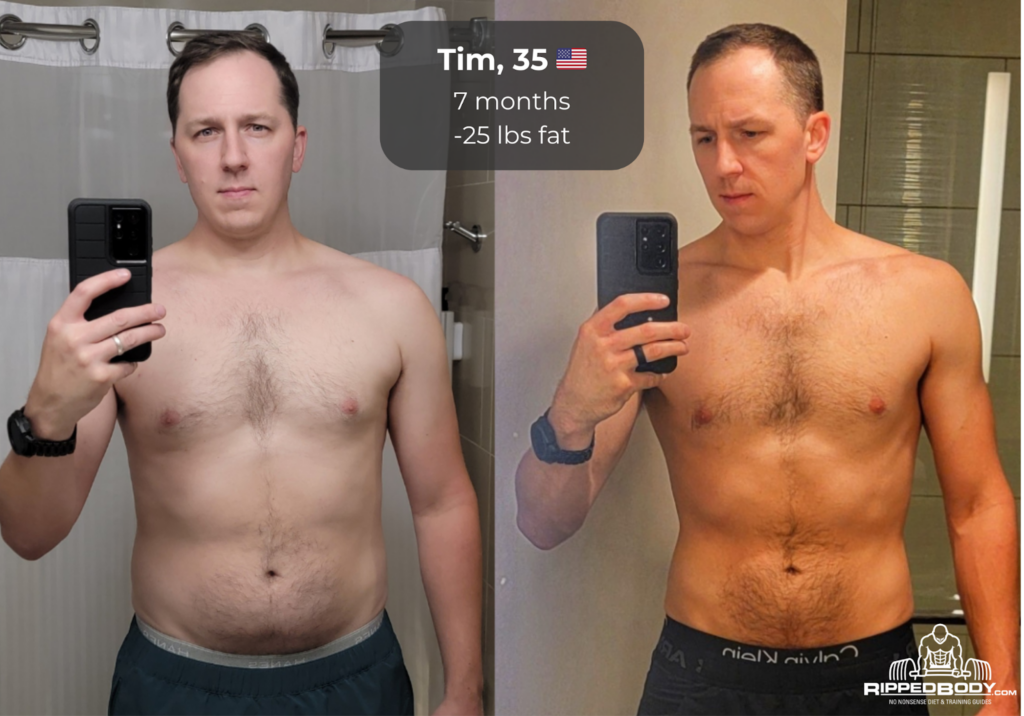
After working with Tim, a pilot and father of three from Seattle for eight months, I’m certain of one thing: If Tim can take back control of his health and make a dramatic transformation, anyone can.
Here at Ripped Body, we work with a lot of men who have career stress, a busy family life, and regularly travel for work, but Tim’s situation takes the cake.
He’s a pilot with a U.S. commercial airline, which means he literally travels for a living and is always on the go. On top of that, he dealt with significant stress throughout our entire coaching journey, yet refused to quit.
Despite having every reason to struggle and give up, he persisted, losing 27 lbs in 30 weeks, even through the busy holiday season.
While many of our case studies focus on the objective data and coaching decisions we make to help our clients break plateaus, in Tim’s case, the initial plan (nutrition targets and training plan) didn’t need any significant adjustments, so this case study will focus on how he stayed consistent through the ups and downs. He didn’t back down or waver, despite having every challenge thrown his way.
This is Tim’s story.
Tim’s Motivation to Get Started
When Tim reached out to us for coaching, like many of our clients, he had reached a point where he knew he could no longer allow his health to deteriorate.
A lot of guys reach out when they have a health scare. But Tim’s turning point came when he lost a childhood friend sparking the desire to take care of his own health.
Along the way, he switched jobs to begin flying for a different airline, which is stressful enough, but in addition to this, about a year before hiring us, his wife was diagnosed with a serious medical condition that left her unable to work and requiring ongoing care and support.
Despite dealing with more stress than I can imagine and a very busy travel schedule, Tim’s transformation was successful for two reasons.
- He had a strong ‘why’ to help him stay focused on the goal
- We developed systems to keep him on track.
Tim’s “Why” for Making a Change
Many of us know we should make a change, but getting started and staying consistent for months on end isn’t easy. To achieve any goal that requires sacrifice, we need a strong reason to help us stay focused when the going gets tough.
In Tim’s case, the passing of his friend was an eye-opening moment, along with his wife’s health challenges.
He knew that prioritizing his own health was a non-negotiable if he wanted to be a good example for his children and provide for his family, and he felt his energy was lacking. Since he hadn’t been taking the best care of his own health, he didn’t feel like he was operating at 100%.
Tim said, “I signed up with you guys because I know that life keeps happening–And I’ve had no energy to be anything more than a passenger, which is not ok with me.”
He wanted to feel better and be a better example for his family, which is a powerful motivator.
For those who struggle to stay consistent or get started in the first place, you need to think deeply about why you want to make this change. Get clear on your reason, write it down, and use it as a reminder when the inevitable challenges of the real world get in the way.
Andy wrote an article about this here.
Tim’s Systems for Success
So you’ve decided to get in shape, you have a clear “why” you’re doing this, and it’s off to the races. Motivation is high when we begin a new challenge, but it’s our systems that keep us going when life gets in the way.
Regardless of your situation, challenges will arise, and having the right plans and systems in place is the key to staying on track. The systems you develop act as guardrails, which is one of the main things we help our clients with.
It’s not realistic to expect smooth sailing, but planning ahead can help you navigate the challenging times. If you’re simply relying on motivation and hoping for the best, it’s going to be a tough journey.
Here are the key systems that helped Tim continue to reach his goals, despite a busy schedule, fatigue, and relentless stress.
System #1: Prioritize Regular Movement
Many of us sit all day for work, and as a pilot, Tim was no different.
However, in addition to maintaining our regular workout schedule, he stayed active whenever possible. Whether it was doing stuff with his kids when he was home or walking around the airport to boost his step count before a long flight, he prioritized regular activity.
His step count averaged 9,400 throughout our entire coaching process. This is an impressive number, especially for someone whose job involves extended periods of sitting.
The takeaway? Even if you’re not going to the gym very often, you can probably find ways to move around. Stand up to take calls, go for short walks after meals, take the stairs instead of the escalator… these small changes compound over time and can make a significant difference.
System #2: Control What You Can
Life on the road isn’t easy, especially when the easiest meals to get come from airport restaurants and layover hotels.
Tim understood that even if he couldn’t be perfect in all situations, he could always give it his best effort.
As he’d often fly to the same airports, we took note of the restaurants he had available, and planned options that would fit his needs so that he wasn’t ever deciding when tired or by hunger levels. Sure, he had a few team dinners or meals he enjoyed with coworkers while on the road from time to time, but he made good choices when possible, and the indulgences were the exceptions rather than the norm.
We discussed in advance that things wouldn’t always be smooth sailing. Rather than panicking and cutting calories after an over-indulgent day in reaction to a sudden weight change, we focused on simply getting back on track with the usual plan.
Here’s what Tim had to say about that.
“When failure struck, I used to get into a spiral of bad decisions. But through the coaching, I’ve learned not to let the setbacks bother me as much and keep telling myself that progress is still happening as long as I stick with it.”
System #3: Change Your Mindset
While this isn’t exactly a system that you can quickly put into place, changing the way you think about things is critical for success.
Before working with us, Tim had some reservations. He told us that he’d struggled to get in shape in the past, and doubted his own ability to stick to the plan.
This is exceptionally common. We’ve had countless clients tell us this over the years, so we shift our focus to building confidence.
I watched him continue to put in the work and overcome obstacles, like working for a new airline, supporting his wife during further health complications, and, of course, navigating his hectic travel schedule. Over time, I saw Tim’s mindset change, and this was one of the key reasons he did so well.
He told me, “This has been a lot of fun so far. My mindset has gradually changed from ‘I want to be a fit person’ to ‘I am a fit person’ because I keep doing the thing(s) that fit people do. It’s been a slight, but powerful shift in my identity.”
Tim’s Transformation Plan
As I mentioned earlier, Tim’s plan didn’t require many adjustments on my end, which is why I’ve saved this part for last. The results — 27 lbs of weight loss in 30 weeks — were impressive, but more impressive was the consistency and “can-do” attitude he brought to the process.
Here’s how we did it.
The Initial Cut
Most of Tim’s weight loss happened in the first 19 weeks, when he cut from 188.7 lbs to 162.9 lbs. That’s 25.8 pounds of weight loss, at an average pace of 1.4 pounds per week.
His calories were set at 2100, aiming for a minimum of 165 grams of protein, and we never had to adjust the goal. You can see from his measurements (in centimeters) that he lost 15 cm (6 inches) around the stomach..

During this time, he followed a 4-day upper/lower split, similar to our intermediate bodybuilding plan, modified to his preferences and equipment availability when on the road.
Holiday Maintenance
As Thanksgiving approached, Tim was struggling with fatigue, both physical and mental. After losing so much weight, this comes as no surprise.
While we often use shorter diet breaks during extended cuts, in Tim’s case, we decided to try slightly increasing calories to slow the rate of weight loss and ease some of the fatigue.
It helped, but eventually, we decided to fully embrace maintenance for the rest of the holiday season and let his body recover from the long diet.
Whenever you’re deep into a diet, your body will be depleted, with less food in your digestive system and less glycogen being stored.
Eating more food will refill muscle glycogen stores, which increases water retention, and along with the water weight, you’ll have more food in your gut, which will show up on the scale.
We expected to see a few pounds of weight gain when increasing calories, and this is exactly what happened when we added in 250 kcal to slow down weight loss (see week 19 to week 20). However, we could be confident this wouldn’t be fat regain, because his estimated calorie deficit was 700 kcal.
(It requires a daily deficit of 500 kcal to lose 1 lb per week. Tim’s average rate of weight loss until that point was 1.4 lbs per week. 500*1.4 = 700 kcal.)
The weight increase came from the higher food intake, particularly carbs, refilling depleted muscle stores (and taking on more gut content), not accumulating body fat.
Interestingly, when we went all the way up to 2,650 calories to get out of the deficit (week 23), his measurements slightly increased, but his average weight actually started to trend down.

Ongoing Maintenance
While we initially discussed heading straight into a bulking phase after the holidays, Tim decided he’d rather practice maintaining his new low bodyweight for a while, which is a great plan for his situation.
After losing a significant amount of weight, it can be a little scary to start adding food and immediately focusing on weight gain. If that’s you, there’s absolutely nothing wrong with settling at maintenance for a while to get comfortable with your new weight, even if you eventually decide to bulk down the road.
In Tim’s case, his goal isn’t to step on a bodybuilding stage with as much muscle and as little fat as possible. His goal is to maintain his new healthy weight, have more energy to do stuff with his kids, and even start training in Brazilian Jiu-Jitsu with them.
All of this is very achievable without having to spend your whole life focused on the gym.
If you don’t want to spend your entire life focusing on getting jacked, simply focusing on maintaining your weight and enjoying other activities is a fantastic goal. Tim’s been maintaining very well on his own, and I have no doubt he’ll continue to do so until he decides to bulk or cut again down the road.
Final Thoughts
As you can see, Tim is the real hero here. He put the systems in place, allowing him to stay consistent despite a busy schedule, worked hard, kept a “can-do” attitude, and it all paid off.
Here’s what he had to say about the experience.
“I’ve tried many things in the past to get adherence to stick, but nothing did. The difference this time was the fear of letting my family down if I didn’t get this sorted.
My wife and kids depend on me to be healthy, my job requires me to be healthy, or I lose my medical, and my day-to-day was just too hectic to have as little energy as I did. And then seeing a good friend pass due to poor lifestyle choices was the extra wake-up call I needed to jumpstart the process. Ripped Body was incredibly valuable to have accountability and someone to report to, to help keep me honest.”
Tim faced more challenges than many of us, yet still managed to take control of his health, become a strong example for his friends and family, and he’s continuing to maintain his weight loss.
It was so inspiring to watch his progress, and hopefully, it’s inspiring to you, too.
Key Takeaways
- Having a strong “why” will help you stay on track when challenges arise.
- Build systems that keep you on track when life gets tough, and avoid relying on motivation.
- Developing a proper mindset and shifting how you think are powerful tools for change.
- Perfection isn’t realistic, and there will always be challenging situations, but that doesn’t mean you need to give up. You can still give it your best effort and control what you can, and there’s no need to beat yourself or feel guilty when you can’t.
If you’re struggling to do this alone and you’re interested in our coaching services, you can apply here. We may have a waiting list, but you can always reach out to see if you’re a good fit and get personalized advice from Andy.

Privacy policy.