


Updated: 28th December, 2025
This is a sample chapter from the 3rd edition of our bestselling book: The Muscle and Strength Pyramid: Training.
It links the main points from each chapter and is a step-by-step guide to building a training program for bodybuilding or powerlifting.
We’ll take you through each level of The Training Pyramid, highlighting the main points and the subsequent decisions you’ll need to make at each level as they relate to building a program.
CONTENTS:
(Click to jump to the corresponding section.)
- Step 1: Adherence
- Step 2: Volume, Intensity, and Frequency
- Step 3: Progression
- Step 4: Exercise Selection
- Steps 5 and 6: Rest Periods and Tempo
- Warming Up
- Dual Athletes
👉 To see these programming principles brought to life, you can view our sample programs here.
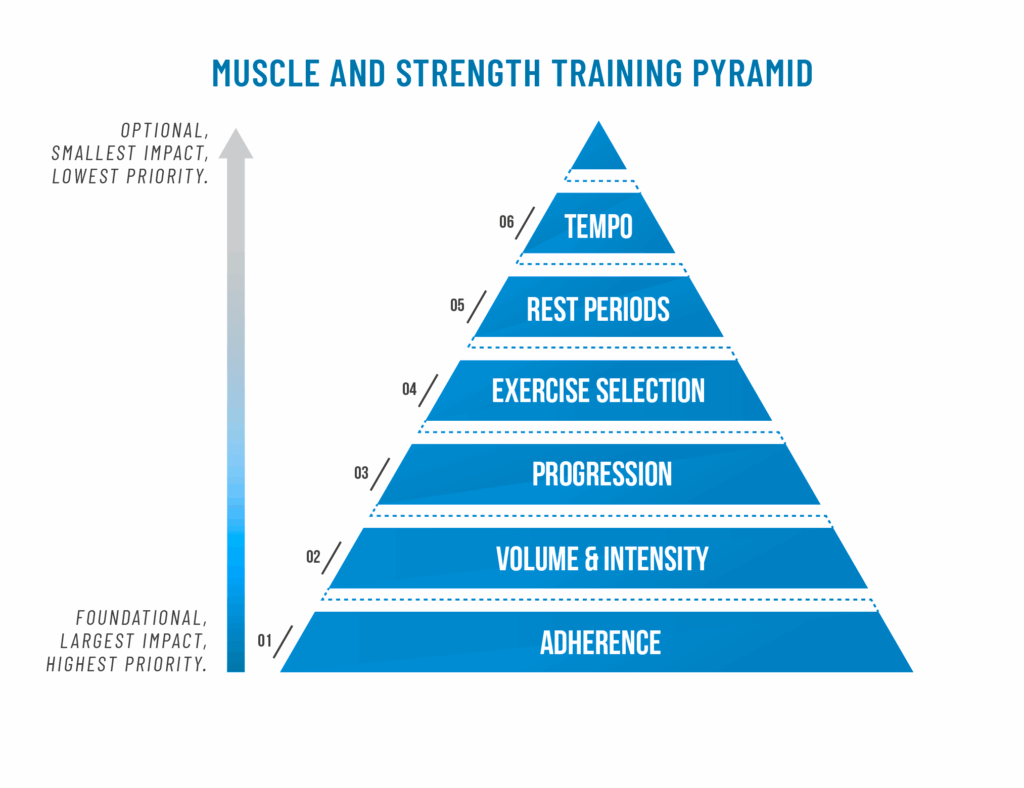
Step 1: Adherence
Plan your workout frequency with adherence in mind.
The main takeaway of Level 1 is selecting how many days per week you train. Choose a realistic number of training days that would not stress your life or schedule. This value can be anywhere from two or more days per week.
Decide whether fewer, longer sessions or more frequent, shorter sessions suit you better. Your training experience interacts with this decision, as at a certain point, it is challenging for most people to progress (although maintenance is certainly feasible) without training at least three times per week. For advanced lifters, a two-day schedule is rarely practical as the loads and volumes required make each workout a gruelling marathon.
Once you’ve set your weekly training schedule, you can choose from several possible setups (often referred to as “splits”).
Frequency Splits for Powerlifting
The Strength Frequency Matrix for Choosing Splits table shows example training splits for powerlifting-focused strength work. Remember: any movement that trains the same muscles as a main lift, but is not the main lift itself, adds 0.5 to your weekly frequency for that lift. For example, a squat session also contributes 0.5 to your weekly deadlift frequency, and vice versa.
As you might recall, ideally, you train each lift with a frequency of at least twice per week. However, if you can only train twice per week, this requires two days where you perform all three main lifts (if you are following a powerlifting program), which may not be feasible for everyone. Thus, we provide examples of weekly lift frequencies in the 1.5–2x per week range as well.
Anecdotally, most powerlifters find squats create less next-day discomfort and soreness than deadlifts, so our examples lean toward higher squat frequency. If you find the opposite is true for you, feel free to reverse this emphasis. Find your available training days in the left column. The rows to the right show split options, with weekly main-lift frequencies (not counting secondary lifts) listed at the top. Remember: a secondary lift that trains the same muscle groups will add 0.5 to your weekly frequency for that main lift.
Find your available training days in the left column. The rows to the right show split options, with weekly main-lift frequencies (not counting secondary lifts) listed at the top. Remember: a secondary lift that trains the same muscle groups will add 0.5 to your weekly frequency for that main lift.
| TABLE 7.1. STRENGTH FREQUENCY MATRIX FOR CHOOSING SPLITS | ||||||
|---|---|---|---|---|---|---|
| Days Per Week | Main Lift Frequency Per Week | |||||
| 1.5–2 | 2 | 2–3 | 3-4 | 4-5 | 6 | |
| 2 | S/B, B/D | S/B/D, S/B/D | NA | NA | NA | NA |
| 3 | S/B, B, D | NA | S/B, B/D, S/B | S/B/D, B, S/B/D, B | NA | NA |
| 4 | S, B, D, B | S/D, B, D/S, B | S/B, B, D, S/B | S/B, B/D, S/B, B/D | S/B/D, B/S, S/B/D, B/D | NA |
| 5 | S, B, D, B, Secondaries | S/D, B, D/S, B,Secondaries | S/B, B, D, S/B, Secondaries | S/B, B/D, S/B, B/D, Secondaries | S/B, B/D, S/B, B/D, S/B | NA |
| 6 | S, B, D, B, Secondaries, Secondaries | S/D, B, D/S, B, Secondaries, Secondaries | S, B, D, B, S, B | S, B, D, B, S/B, B/D | S/B/D, B, D, S/B, B/D, S/B | S/B/D, S/B, B/D, S/B/D, S/B, B/D |
S = Squat
B = Bench
D = Deadlift
NA = Not applicable
“/” indicates performed in the same session, commas separate days.
Frequency Splits for Bodybuilding
For hypertrophy training, you have a lot more room for flexibility in your split. Remember that, unlike strength, muscle group frequency has a very small impact on your outcomes. Therefore, you can see the matrix displays a non-exhaustive list of approaches you can use. The main goal when designing your split is to avoid sessions becoming logistically impractical, overly fatiguing, demotivating, or exceeding roughly 11 sets per muscle group per session.
When you view the Sample Programs spreadsheet, you’ll see that we’ve used an arrangement that differs from most traditional bodybuilding setups. Specifically, we alternate between primarily:
- Chest & Back with Quads & Calves
- Arms & Middle/Rear Delts with Glutes & Hamstrings
In prior editions of The Pyramids, we provided traditional sample programs, such as Upper/Lower, Full Body, and Body Part splits. These are so commonplace now that we believe you should have no issue translating the guidance in this book into those types of splits. Thus, we aim to provide you with even more examples of how to divide up your volume in a week; we are not implying that those types of splits are inferior by omitting them in our Sample Programs spreadsheet.
In addition, the frequency matrix will help you learn all the options you can use to find the best balance between stimulus and recovery. In our experience, especially when trying to achieve higher volume approaches, most traditional approaches (body part splits, lower/push/pull) are not ideal for optimizing the balance between recovery and stimulus, so being more creative is important as you advance.
The Hypertrophy Frequency Matrix for Choosing Splits table will help you explore both traditional and non-traditional options. Start by finding the number of days you can train in the left column, then review the potential split options in the right column. The top row lists the weekly training frequency for each muscle group, which includes fractional frequency from indirect work. If you aren’t sure of what any of the session types refer to, see the descriptions below the matrix.
Even when using classical bodybuilding splits, where you only train each muscle group once per week, because of indirect work producing fractional sets (i.e., bench press indirectly trains the triceps, adding 0.5 to triceps weekly frequency), few training splits provide a true weekly muscle group frequency of only one.
| TABLE 7.2. HYPERTROPHY FREQUENCY MATRIX FOR CHOOSING SPLITS | ||||||
|---|---|---|---|---|---|---|
| Days Per Week | Muscle Group Frequency Per Week | |||||
| 1-2 | 2 | 3 | 4 | 5 | 6 | |
| 2 | Upper, Lower or Full Push, Full Pull | Full Body, Full Body | NA | NA | NA | NA |
| 3 | Lower, Upper Push, Upper Pull | Lower, Upper, Full Body or Full Push, Full Pull, Full Body | Full Body, Full Body, Full Body | NA | NA | NA |
| 4 | Chest & Tris, Back & Bis, Shoulders, Lower | Lower, Upper, Lower, Upper or Full Push, Full Pull, Full Push, Full Pull | Upper, Lower, Full Body, Full Body or Full Push, Full Pull, Full Body, Full Body | Full Body, Full Body, Full Body, Full Body | NA | NA |
| 5 | Chest, Back, Lower, Shoulders, Arms | Lower, Upper Push, Upper Pull, Lower, Upper or Lower, Upper Push, Upper Pull, Full Push, Full Pull | Lower, Upper Push, Upper Pull, Full, Full | Full Body, Full Body, Full Body, Upper, Lower or Full Body, Full Body, Full Body, Full Push, Full Pull | Full Body, Full Body, Full Body, Full Body, Full Body | NA |
| 6 | Chest, Back, Quads & Calves, Shoulders, Arms, Glutes & Hams | Lower, Upper Push, Upper Pull, Lower, Upper Push, Upper Pull | Lower, Upper, Lower, Upper, Lower, Upper or Full Push, Full Pull, Full Push, Full Pull, Full Push, Full Pull | Full Body, Full Body, Full Body, Lower, Upper Push, Upper Pull | Full Body, Full Body, Full Body, Full Body, Upper, Lower or Full Body, Full Body, Full Body, Full Body, Full Push, Full Pull | Full Body, Full Body, Full Body, Full Body, Full Body, Full Body |
NA = Not applicable
Session Type Descriptions for the Hypertrophy Frequency Matrix
Muscle Group Sessions
Train one or two muscle groups (e.g., chest; chest and triceps; back; back and biceps; quads and calves; shoulders, etc.), allowing high muscle-group volume per session without excessively long workouts. These sessions require a longer recovery time for the trained muscles, resulting in a lower weekly frequency. Best suited for low to moderate weekly muscle group volumes (~4–12 sets). Less effective for higher weekly volumes unless combined with other session types (e.g., a 4-day upper/lower split plus 1–2 muscle group sessions for specialization).
Upper Push or Pull Sessions
Used in the popular “Legs/Push/Pull” split, these train all upper-body pushing muscles (chest, triceps, anterior delts) or pulling muscles (back, biceps, rear delts). Choose one day to train middle delts. This structure allows reasonably high volume without excessively long sessions. Suitable for low to moderate weekly volumes when performed once per week, but can also support moderate to high weekly volumes (~12–24 sets) if performed multiple times per week (e.g., a 6-day repeated legs/push/pull split) or combined with other session types (Full Body, Upper, Lower, Full Push, Full Pull).
Upper or Lower Sessions
Train the entire upper or lower body together. Allows moderate muscle-group volume without overly long sessions. Works well for low to moderate volumes when performed once per week, and moderate to moderately high volumes (~12–18 sets) when performed twice per week (e.g., a 4-day Upper/Lower split). Higher volumes are possible if alternating six days per week or combining with other session types (e.g., Full Body, Full Push, or Full Pull). Note: Lower body sessions are disproportionately challenging due to the loads and number of muscle groups trained. Non-traditional approaches may be better for those seeking very high lower-body volumes.
Full Body Sessions
Train the entire body to some degree in each session. A strict “full body” approach (training all muscle groups in every session) limits per-session muscle-group volume unless workouts become very long. Works well for low to moderate weekly volumes when used 2–3 times per week, and can support moderate to moderately high volumes (~12–18 sets) when used 3+ times per week or combined with other session types. Higher volumes are possible at 5+ sessions per week with careful programming.
Because per-session muscle-group volume is low per session, training muscle groups on consecutive days can occur without compromising recovery, provided RIR, muscle length, and exercise selection are managed to avoid excessive overlap and fatigue.
Full Push or Pull Sessions
Combine an upper push or pull session with lower-body work: push days include quads and calves; pull days include glutes and hamstrings. Like the non-traditional approach in the sample programs, this is a non-strict interpretation of “full body.” Because you aren’t attempting to perform an entire leg day, these sessions allow a higher muscle group volume per week without any single session becoming too long and therefore too physiologically or psychologically demanding. Alternating these sessions is a good alternative to the sample programs for those who wish to train on consecutive days, especially if you experience a negative impact of prior-day arm training on chest or back performance, or vice versa. Supports a wide range of weekly volumes:
- Low if done twice per week with shorter sessions.
- Moderately low to moderately high if done 3–4 times per week.
- Very high if alternated 5+ times per week with moderate session lengths.
Key Programming Note
With the same total weekly volume, your chosen split determines how much work each muscle group gets per session and, therefore, session length.
- Six “full body” days → fewer exercises per muscle group, fewer sets per exercise, shorter sessions.
- Two “full body” days → more exercises per muscle group, more sets per exercise, longer sessions.
In the hypertrophy sample programs, higher weekly volumes are paired with higher frequencies, and vice versa.
In strength training, the frequency matrix is organized around how often you train the:
- Bench press.
- Squats and deadlifts combined (due to overlap in stimulus and stress).
Very high or very low frequencies can be problematic. Overloaded sessions can cause performance drop-off, while high frequencies may cause joint or connective tissue stress regardless of total volume.
For ~90% of lifters, train 3–5 days per week with a muscle/movement frequency of 2–4 times per week, as this typically strikes the best balance between stimulus and recovery.
Pencil in the split you’ve chosen for now, because in step two, we’ll discuss some other potential considerations that might impact your decision.
Step 2: Volume, Intensity, Frequency
Set appropriate Volume, Intensity, Frequency for your workouts.
As a reminder, these are the broad starting guidelines appropriate for most people:
| TABLE 7.3. VOLUME • INTENSITY • FREQUENCY SUMMARY OF STARTING RECOMMENDATIONS | ||
|---|---|---|
| Hypertrophy | Strength | |
| Volume1 | ||
| Minimum ED2 | 4 sets/muscle/wk, increases w/training status. | 1 set/lift/wk, increases w/training status. |
| Maximum ED3 | ~30 sets/muscle/wk | ~5 sets/lift/wk (short-term) |
| Practical ED4 | 10–20 sets/muscle wk, Higher volume with specialization. | 3–5 sets/lift/wk (short-term), 5–10 sets/muscle/wk (long-term). |
| Intensity5 | ||
| Load | ~4–30 RM (~30-90% 1RM) | 1–8 RM (~80+% 1RM) |
| RIR | 4–0 RIR and failure per load/rep combination. | ~7–0 RIR per load/rep combination. |
| 4–6 reps/set: 4-0 RIR | Load, not RIR, dictates strength. RIR is a function of load. Higher loads allow fewer reps and are inherently closer to failure. | |
| 6–8 reps/set: 3 RIR to failure | ||
| 8–12 reps/set: 2 RIR to failure | ||
| >12 reps/set: 1 RIR to failure | ||
| Frequency6 | ≥1x/muscle/wk based on volume. If performing >11 weekly sets per muscle group, increase frequency so no session exceeds 11 fractional sets per muscle group. | 2–6x/lift/wk based on volume. Higher frequency provides some benefit. Spread sets over as many days as possible with 1–2 direct sets per main lift per session. |
| 1As fractional sets. Hypertrophy: sets count as full sets for primary muscles, half for secondary. Strength: tested lift sets count as full sets, other lifts training primary or secondary muscles as half. 2Lowest volume to produce measurable gains in 2–3 months. For hypertrophy in trained lifters, requires low RIR (near or to failure). For strength in trained lifters, requires high specificity (high load and on specific lift). Use if ideal training can’t occur. Produces progress in novice-intermediate, maintenance in intermediate-advanced. 3Volume threshold when diminished returns reach a plateau. 4Appropriate range for real-world, long-term training. Individual differences and circumstances dictate where to fall in these ranges. Higher volumes closer to maximum ED only advised for advanced lifters via specialization cycles. Long-term strength gains require hypertrophy; thus, some hypertrophy volume in high efficiency range recommended. 5High load effective for hypertrophy at high RIR but sets must be ≥4 reps. RIR underestimation more likely at low loads. 6 High volume best distributed with high frequency for hypertrophy, higher frequency strength practice beneficial. | ||
Determining Volume
You’ve already penciled in your frequency in Step 1. Next, it’s time to choose an appropriate volume.
Remember, “optimal” depends on your circumstances and goals:
- For hypertrophy with minimal time, optimal might mean the lowest volume that still produces good returns.
- For a competitive bodybuilder, optimal might mean maximum achievable volume for the highest possible rate of muscle gain.
- Your training history also matters. If you have detailed logs showing your rates of progress at different volumes, use them to guide your choice. If not, start tracking now and adjust in future cycles. For now, consider your time availability and perspective on “optimal” in your decision.
| TABLE 7.4. HYPERTROPHY VOLUME TIERS BY TIME COMMITMENT, AVERAGE STIMULUS PER SET, AND TOTAL STIMULUS | |||
|---|---|---|---|
| Weekly Sets per Muscle | Time Commitment | Average Stimulus Per Set | Total Stimulus |
| 4–8 | Minimal (~1-2.5 hours) | Highest | Lowest (~25-45% of highest tier) |
| 9–12 | Low (~3-4.5 hours) | High | Modest (~45-60% of highest tier) |
| 13–16 | Medium (~5-6.5 hours) | Medium | Medium (~60-70% of highest tier) |
| 17–20 | High (~7-8.5 hours) | Low | High (~70-85% of highest tier) |
| 21–30 | Very High (~9+ hours) | Lowest | Highest (~85-100% if sustainable)2 |
| 1Often best accomplished via specialization cycles, with other muscle groups in a lower volume tier. 2If RIR increases, technical execution degrades, effective exercises are dropped, or frequent deloads occur (causing lower net volume), overall stimulus may not be the highest. | |||
Determining Frequency
The higher your weekly volume, the more sense it makes to spread it over more sessions. This:
- Prevents excessively long, fatiguing sessions.
- Maintains session quality.
- Increases skill practice for strength goals.
As a reminder from Level 2, our frequency per lift or per muscle group recommendations are inextricably linked to weekly volume, session volume, and the number of weekly sessions performed.
| TABLE 7.5. FREQUENCY RECOMMENDATIONS | |
|---|---|
| Goal | Frequency Guideline |
| Hypertrophy | ≥1x/week per muscle group, based on volume. If you exceed ~11 fractional sets for a muscle in a session, increase frequency to distribute volume better. |
| Strength | 2–6x/week per lift, depending on volume. Spread sets across as many sessions as possible, with 1–2 direct sets per lift per session. |
| High volume is best distributed with higher frequency for hypertrophy, and increased frequency offers benefits for strength by enhancing skill practice and movement quality. | |
| TABLE 7.6. FREQUENCY RECOMMENDATIONS BY VOLUME | |
|---|---|
| Weekly Fractional Sets Per Muscle | Weekly Frequency Per Muscle |
| 4–10 | 1–2 |
| 11–20 | 2–3 |
| 21–30 | 3+ |
If your volume doesn’t match well with your Step 1 split, either:
- Adjust your total volume.
- Adjust your split choice.
Hypertrophy Volume Distribution Example
With your volume level and frequency chosen, if your goal is hypertrophy, you will spread that volume for each muscle group across the week. Once again, just pencil this in to get an idea of how your week is shaping up.
For example, let’s say you are doing 13–15 sets per muscle group with a 4-day, two times per week muscle group frequency, doing a ‘Lower, Upper Push, Upper Pull, Full Body’ split. Spreading things out, you’d probably do 4–6 sets per muscle group on your Full Body day, leaving 9–11 sets per muscle group for your Legs, Push, and Pull days.
- Goal: 13–15 sets per muscle group per week.
- Split: Lower / Upper Push / Upper Pull / Full Body.
- Full Body day: 4–6 sets per muscle group.
- Other days: 9–11 sets spread across targeted muscles.
Strength Considerations
If your goal is strength, you’d take the same approach as someone with a hypertrophy goal for your secondary work, but you also have the added complexity of determining your main lift frequency. The total volume for your main lifts will be lower than your secondary work, and you’d want to have a relatively high frequency to facilitate faster gains through frequent main lift practice. Thus, you have to think about how to spread out your main lift work to ensure recovery from your secondary lifts so that muscle soreness doesn’t impede strength.
However you distribute your volume across your frequency selection, make sure you aren’t putting a lot of lower body secondary work prior to squat or deadlift main lift training, or a lot of upper body pressing secondary work prior to bench press main lift training (apply the same principles to other main lifts if you aren’t using the powerlifting main lifts).
- Secondary work: Same volume/frequency approach as hypertrophy.
- Main lifts: Lower total volume but higher frequency to improve skill.
- Avoid interference: Don’t schedule heavy secondary work for the same muscle group the day before main lift training (e.g., avoid lots of quad work before squats, lots of pressing before bench).
Determining Intensity
Once you’ve set your frequency and volume, the final step in Step 2 is to assign load and RPE/RIR.
The chart shows appropriate repetition ranges and RPE/RIR values for hypertrophy (including hypertrophy work for strength goals) based on exercise and microcycle organization. Note that the chart provides a little more specificity than the main volume, intensity, frequency table, as it also considers exercise selection, such that while 0 RIR can be appropriate for low-rep high-load training for hypertrophy, it’s not ideal for most free weight compound lower body and upper body pressing exercises for safety, or even lower compound machine exercises for fatigue management.
Likewise, while the 4–6 rep range can be used for hypertrophy, the resistance profile of certain exercises (most back training and many isolation exercises) makes it challenging to maintain form, and for those prone to joint discomfort or with prior injuries, it might be better reserved for compound exercises.
| TABLE 7.7. REP AND RPE/RIR RANGE COMBINATIONS FOR HYPERTROPHY BY EXERCISE TYPE | ||
|---|---|---|
| Exercise | Rep Range | RPE/RIR Range |
| Lower Free Weight Compound (squat, deadlift, RDL, etc.) | 4–8 | 6–8 RPE/4–2 RIR |
| Lower Machine Compound (leg press, hack squat, etc.) or Upper Free Weight Pressing (OHP, bench, incline DB, etc.) | 4–12 | 6–9 RPE/4–1 RIR |
| Upper Machine Pressing (machine chest or shoulder press, etc.) or Pulling Compound (lat pulldown, BB row, cable row, etc.) | 6–15 | 7–10/3–0 RIR and failure |
| Isolation (curls, tricep pushdown, calf raise, leg extension, lateral raise, etc.) | 8–20 | 8–10/2–0 RIR and failure |
For hypertrophy (and secondary work for strength), the higher the fatigue generated by the movement, the greater the technical demand, and the greater the safety risk. Therefore, it makes more sense to train further from failure and use a higher load to ensure the set retains its full stimulus. This avoids fatigue bleeding into the rest of a session, may reduce the risk of injury, and also ensures that the volume you perform is effective because, as discussed in previous chapters, it’s harder to accurately rate RPE on high-rep, fatiguing movements. Compound movements are generally a better vehicle for doing the portion of your volume that is lower rep and further from failure, and thus heavier. Likewise, isolation exercises and machines are better vehicles for the higher-rep, lower-load portion of your volume.
For main lifts trained for strength, remember that load is the driving force for adaptation. Therefore, the set, repetition, load, and RPE/RIR combinations heavily depend on your goal with the movement on that day, in the specific phase of training. This means there is no “cheat sheet” as you might decide to do a single at a 5 RPE/5 RIR 16 weeks out from a meet to maintain skill while producing minimal fatigue, or you might do so days from the meet during your taper to maintain peak levels of strength while dissipating fatigue. Ultimately, repetition and RPE/RIR combinations for your main lifts will be dictated by specificity and proximity to when you want to peak strength, with load dictating RPE/RIR. For examples of how these manipulations might occur over time, see the example strength programs as they go from volume to load to peak phases.
When you combine this information with Step 3, you can really start to see how your program unfolds.
Step 3: Progression
Choose your progression strategy.
At this stage, your program begins to take its final shape. You’ll now decide how to assign reps and sets across weeks and phases. Your approach depends on your goal: hypertrophy or strength.
Implementing Rep Range Variation and Specialisation Phases
For hypertrophy, as you recall from Level 3, you simply need variation in your repetition ranges, a plan to accommodate potentially unwieldy high volumes if you’re advanced and trying to use them to offset the natural slowing in your rate of hypertrophy, and a system to ensure progression to keep pace with your adaptations, maintaining the effectiveness of each set.
First Step → Decide how you’ll incorporate rep range variation. This variation can be applied:
- Within a single session (e.g., one lift in the 6–8 range, another in the 12–15 range).
- Between sessions (e.g., heavy day / light day).
- Between weeks (e.g., rotating rep targets across weeks in a block).
- Between training blocks (e.g., spending several weeks in moderate rep ranges before moving to higher or lower ranges).
| TABLE 7.8. HYPERTROPHY TRAINING STRUCTURES TO ACHIEVE REP RANGE VARIATION | ||||
|---|---|---|---|---|
| Within Session Variation | Lower A: 4–8, 6–10, 10–15, 15–20 rep ranges varying lift to lift. | Upper A: 4–8, 6–10, 10–15, 15–20 rep ranges varying lift to lift. | Lower B: 4–8, 6–10, 10–15, 15–20 rep ranges varying lift to lift. | Upper B: 4–8, 6–10, 10–15, 15–20 rep ranges varying lift to lift. |
| Between-Session Variation | Lower A: 4–6, 6–10, and 8–12 rep ranges on all lifts. | Upper A: 4–6, 6–10, and 8–12 rep ranges on all lifts. | Lower B: 8–12, 10–15, 15–20 rep ranges on all lifts. | Upper B: 8–12, 10–15, 15–20 rep ranges on all lifts. |
| Alternating Week Variation | Week A: 4–6, 6–10, and 8–12 rep ranges on all days. | Week B: 8–12, 10–15, 15–20 rep ranges on all days. | Week A: 4–6, 6–10, and 8–12 rep ranges on all days. | Week B: 8–12, 10–15, 15–20 rep ranges on all days. |
| Alternating Mesocycle Variation | Meso A: 4–6, 6–10, and 8–12 rep ranges all weeks. | Meso B: 8–12, 10–15, 15–20 rep ranges all weeks. | Meso A: 4–6, 6–10, and 8–12 rep ranges all weeks. | Meso B: 8–12, 10–15, 15–20 rep ranges all weeks. |
Additionally, if you are an advanced lifter, you might decide to include specialization cycles to accommodate higher, muscle group-specific volumes in phases to facilitate continued hypertrophy long term as your rate of progress slows.
| TABLE 7.9. MUSCLE GROUP SPECIALIZATION PHASE MESOCYCLES | ||||
|---|---|---|---|---|
| Balanced Phase | Specialization Phase | Balanced Phase | Specialization Phase | Balanced Phase |
| 8–12 weeks, 10–20 sets/wk on all muscle groups. | 8–12 weeks, 20–30 sets/wk on 1–2 muscle groups, 5–15 on remaining. | 8–12 weeks, 10–20 sets/wk on all muscle groups. | 8–12 weeks, 20–30 sets/wk on 1–2 muscle groups, 5–15 on remaining. | 8–12 weeks, 10–20 sets/wk on all muscle groups. |
Implementing Autoregulated Double Progression and Phasic Approaches
With your mid-term plan for repetition range variation established, and your optional long-term plan for muscle group specialization phases (if advanced) determined, the only thing that remains is remembering how to implement autoregulated double progression, which you’ll use for all exercises, which you can see in the Example Autoregulated Double Progression for an Intermediate Lifter table from Level 3.
Refer to our article on Progression for a fuller explanation.
| TABLE 7.10. EXAMPLE AUTOREGULATED DOUBLE PROGRESSION FOR AN INTERMEDIATE LIFTER | |||
|---|---|---|---|
| Here’s how an intermediate lifter’s progression may look for 3 sets of 10–15 reps at 0–2 RIR. | |||
| Session | Load | Reps | First Set RIR |
| 1 | 40 lbs | 12, 12, 11 | 2 |
| 2 | 40 lbs | 13, 13, 12 | 2 |
| 3 | 40 lbs | 14, 14, 12 | 2 |
| 4 | 40 lbs | 15, 14, 14 | 1 |
| 5 | 40 lbs | 15, 14, 14 | 2 |
| 6 | 45 lbs | 11, 10, 9 | 2 |
For a strength program, there is a little more you need to manage, as you need to not leverage specificity while managing fatigue to peak strength in the short term, but also facilitate hypertrophy long term to maximize your strength potential.
For this reason, we recommend a phasic approach, alternating volume and load phases, and implementing peak phases as needed when preparing to test or compete. For your secondary lifts, you’ll use autoregulated double progression just as you would for hypertrophy-focused training. However, the repetition range, RIR/RPE, and volume and frequency of your main lifts will be phase-dependent. The summary tables outline guidelines for structuring each phase of your strength program.
| TABLE 7.11. SUMMARY TABLE: THE VOLUME PHASE | |
|---|---|
| Goal | Build muscle; maintain or build strength. |
| Main lifts | 1–3 singles/lift/week; progress from 5 to 8 RPE (5 to 2 RIR). |
| Secondary lifts | 10–20 sets/week per main lift muscle group; mostly in the 6–20 rep range at 0–3 RIR; autoregulated double progression, primarily non-specific, low-demand exercises. |
| Length | 6–12 weeks per timeline. |
| TABLE 7.12. SUMMARY TABLE: THE LOAD PHASE | |
|---|---|
| Goal | Build strength, maintain/build muscle. |
| Main lifts | 2–4 singles/lift/week; progress from 6 to 9 RPE (4 to 1 RIR). 2 back-off sets/single at 5–8 RPE (5–2 RIR); progress from 5 to 3 reps (~80–85% 1RM). Use variations if needed. |
| Secondary lifts | 5–10 sets/week/main lift muscle group, mostly 6–20 reps at 0–3 RIR; autoregulated double progression, primarily non-specific, low-demand exercises. |
| Length | 4–8 weeks per timeline, gradually reduce secondary lift volume by 1–2 sets every 1–2 weeks (e.g., 10 sets in weeks 1–2, 9 sets in weeks 3–4, 8 sets in weeks 5–6, and 6 sets in weeks 7–8). |
| TABLE 7.13. SUMMARY TABLE: THE PEAK PHASE | |
|---|---|
| Goal | Peak strength, maintain muscle. |
| Main lifts | 2–5 singles/each/week at 7–10 RPE (3–0 RIR); 0–3 back-off sets/single at 5–8 RPE (5–2 RIR). If 3–4 weeks, progress from 4 to 2 reps/set (~85% 1RM). Use variations if needed. |
| Secondary lifts | 0–4 sets/week/main lift muscle group, mostly 6–20 reps at 0–3 RIR; autoregulated double progression; primarily non-specific, low-demand exercises. |
| Length | 2–4 weeks, 2 weeks if the volume and load phase lasted 10–12 weeks, 3 weeks if 13–15 weeks, 4 weeks if 16+ weeks. Decrease the back-off set and secondary lift volume weekly. |
When Progress Plateaus
Finally, you’ll need to consider what to do when progress plateaus. Remember, the first step is determining if you’re actually plateaued, which starts with having realistic expectations for progression based on your training status, as shown in the following table.
| TABLE 7.14. TRAINING STATUS DEFINITION AND ESTIMATED AVERAGE RATES OF PROGRESS | |
|---|---|
| Novice | Able to add load and/or reps each time a lift is repeated in the same week or from week to week. This phase can last for years but may be as short as 6 months with consistent, progressive training, sufficient recovery, and effort. |
| Intermediate | Progress slows. You might add reps in the 10–20 rep range week to week, or add load in lower rep ranges month to month. With appropriate training, most reach this stage by year 1 and may remain here through years 4–5. Many never progress past it. |
| Advanced | Gains are much slower. You may add a rep or two in the 10–20 rep range month to month, or make small increases in reps or load in lower rep ranges over longer timeframes. Progress becomes increasingly difficult as you approach your muscular potential. Most lifters never reach this phase. |
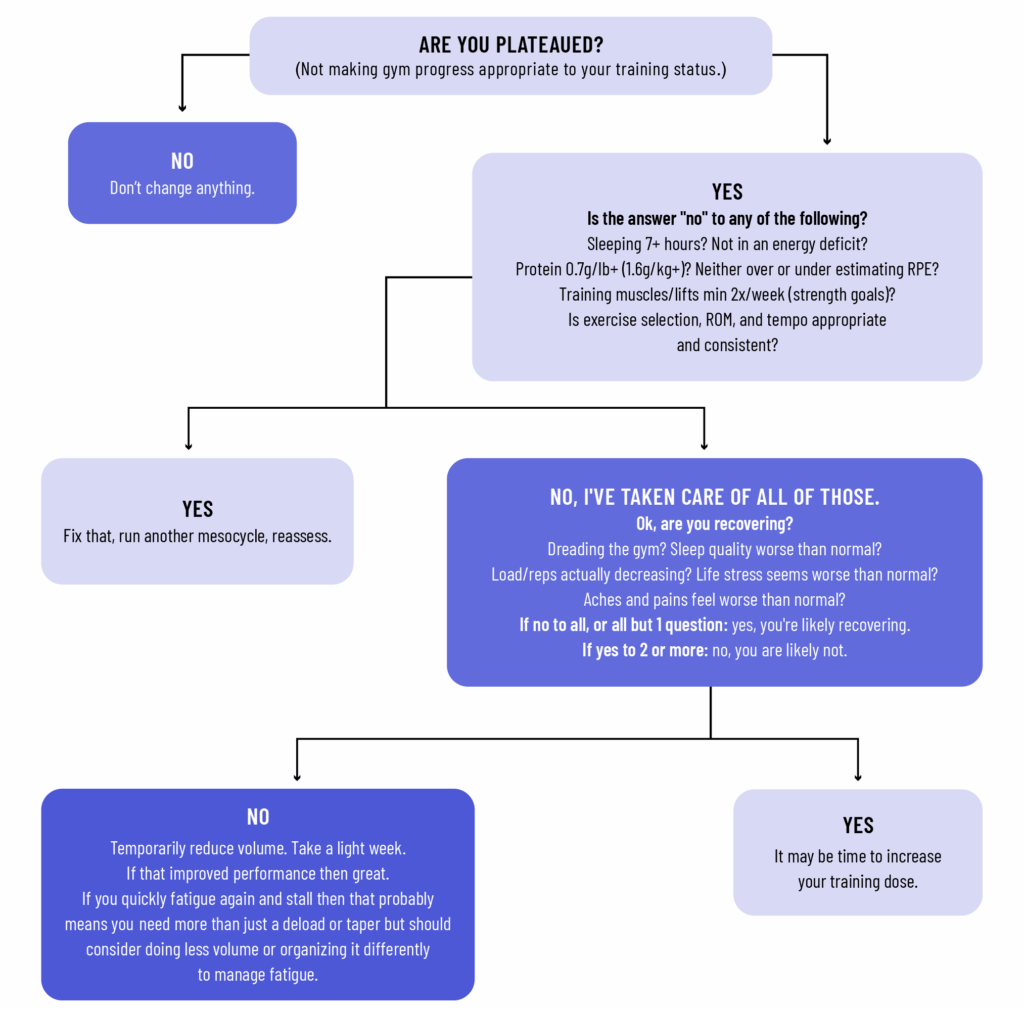
With this understanding, you can then use the plateau flowchart to assess the potential cause and remedy for plateaus you encounter. Finally, remember the utility of reactive deloads based on weekly self-assessments shown below the flowchart, and you’ve got all the tools needed to keep the program on track.
Assessing and Responding To Plateaus Flowchart
| REACTIVE DELOAD SELF-ASSESSMENT TABLE | |
|---|---|
| After completing a week of training and days off are you: | Y/N? |
| Dreading the gym? | |
| Sleep worse than normal? | |
| Loads or reps at the same load, decreasing from the last training cycle? | |
| Sleep worse than normal? | |
| Aches and pain worse than normal? | |
| Yes to 0–1 questions: carry on. | |
| Yes to 2 or more questions: consider a deload. | |
Step 4: Exercise Selection
Now that you know what you’ll be doing in the long, mid, and short term, it’s time to match exercises with the RIRs/RPEs, repetition ranges, and sets you’ve planned. As a reminder, the principles of exercise selection are summarized here in the table from Level 4.
| TABLE 7.16. SUMMARY OF EXERCISE SELECTION RECOMMENDATIONS | |
|---|---|
| Strength | Use your main lifts to achieve the target volume for those lifts unless you have a low tolerance for their total volume. In that case, select variations with high carryover based on your biomechanics, injury history, technical needs, and/or sticking points. For hypertrophy work, choose less fatiguing, higher-rep exercises that are quicker to set up and perform. |
| Hypertrophy | Following the principles of feasibility and ensuring the target muscle is both trained and challenged at long lengths, choose 1–3 lifts for each of the six core movement patterns (Squat, Hip Hinge, Vertical Push, Vertical Pull, Horizontal Push, and Horizontal Pull — 7.17). Include: An incline press. An elbow-flared row plus a shoulder-extension–dominant row. At least one isolation exercise each for the quads, hamstrings, biceps, triceps, middle delts, and calves. |
For hypertrophy and secondary strength exercise selection, slot in lifts to meet your weekly muscle group volume targets. Remember the fractional set counting method:
- For hypertrophy, sets count as 1 for primary muscle groups and 0.5 for secondary muscle groups.
- For strength, sets of the main lift count as 1 for that lift, and all other lifts that train any of the same muscles count as 0.5.
Remember, this is a tracking tool, not a literal representation of stimulus. Some exercises will be more or less effective for growing certain muscles, or will transfer more or less to a given lift. The list below will help you choose exercises and track volume.
| TABLE 7.17. HYPERTROPHY: EXERCISES AND MUSCLE GROUPS TRAINED | ||
|---|---|---|
| Movement Pattern | Primary Muscle Groups | Secondary Muscle Groups |
| Squat (all variations, leg press, single leg variants, etc.) | Quads, Glutes | Erectors (if free weights) |
| Hip Hinge (deadlift variations, good morning, back ext) | Glutes, Hams, Erectors | Scapular Retractors |
| Vertical Pull (chins, lat pull) | Lats, Scapular Depressors | Rear Delts, Bis |
| Vertical Push (OHP variations) | Anterior Delts | Triceps, Middle Delts |
| Horizontal Pull (row variations) | Lats, Scapular Retractors | Rear Delts, Bis, Middle Delts (face pull) |
| Horizontal Push (flat, incline, decline variants) | Chest, Anterior Delts | Tris, Middle Delts (incline) |
| Horizontal Hip Extension (hip thrust, glute bridge, etc.) | Glutes | Hams |
| Pull Over (DB, BB, cable, machine) | Lats | Chest, Rear Delts, Tris (secondary, only long head) |
| Upright Row (DB, BB, cable) | Scapular Elevators, Middle Delts | Rear Delts, Bis |
| Fly (cable, DB, machine) | Chest, Anterior Delts | N/A |
| Isolation Exercises | Target muscle | N/A |
Steps 5 and 6: Rest Periods and Tempo
At this stage, there’s not much left to finalize. Ensure your rest periods are appropriate for your goals on each lift, and that your tempos align with the intended training effect. Consider whether you can incorporate antagonist-paired sets, peripheral-paired sets, drop sets, or rest-pause techniques to save time. Use them only with suitable exercise combinations and if your cardiorespiratory fitness allows.
Congratulations, you’ve now built a fully customized program aligned with The Pyramid!
Warming Up
The purposes of a warm-up are to prepare you for the training to come, potentially enhancing performance, and hopefully reducing injury risk. One of the primary mechanisms by which a warm-up achieves this is by raising body temperature, which has beneficial physiological effects that include increasing muscle blood flow and oxygen availability, and also increasing the speed and sensitivity of the neuromuscular system [1].
Does Stretching Have a Role?
While stretching to enhance flexibility is traditionally performed as a part of a warm-up [1], static stretching to the point where flexibility increases acutely prior to training can reduce strength and power [2]. This makes sense if you think about it: making a muscle tendon unit more compliant and forcing it to “relax” so that it elongates, intuitively conflicts with the goal of making it contract forcefully. Some have argued that this short-term performance drop may be worth it if stretching reduces injury risk, but while warm-ups in general (including stretching of any type) reduce injury risk [3], a 2025 meta-analysis of 15 trials with over 9,000 participants found no independent effect of stretching alone [4]
On the other hand, ‘dynamic’ stretching warm-ups (active bodyweight stretching drills) can actually slightly increase muscular performance [2]. However, static stretching may be useful in cases where you want a targeted improvement in flexibility for a specific joint prior to training that is challenging to achieve with a dynamic warm-up. For example, if tight calves prevent a full ROM squat without rising onto the toes or causing an early “butt wink,” static calf stretching has a clear application.
Fortunately, the data also indicates that combining static and dynamic stretching in warm-up routines, if dynamic stretching is performed last, also improves performance [2]. This approach is especially useful for athletes with high mobility demands, such as weightlifters, where greater depth in the snatch or clean & jerk allows heavier lifts, or powerlifters who need extra ROM to achieve pain-free bar positioning (e.g., tight pecs or shoulders in the low-bar squat, or tight triceps/forearms in the clean-grip front squat). In each case, static and/or dynamic stretching prior to training may be appropriate. So long as stretching concludes with a dynamic approach, there will be no harm and likely a small benefit.
In practice:
- If you need flexibility in a muscle you aren’t training (e.g., pecs and delts during low-bar squats), static stretch freely, as its reduced contractile force won’t matter.
- If you need flexibility in a muscle you are training:
- If the ROM requirement is minor, brief static stretching (<60 s) not taken to discomfort is fine, but it won’t meaningfully increase flexibility.
- For greater needs, follow static stretching with dynamic stretching, or use an extended, lift-specific warm-up, gradually increasing ROM each rep.
- Foam rolling for ~60 s with moderate pressure can also increase ROM and, like dynamic stretching, may slightly boost performance [5].
Thus, you can do static stretching, dynamic stretching, or foam rolling in a warm-up, so long as it doesn’t conclude with long-duration static stretching, to get beneficial effects on performance and slightly reduce injury risk. Ultimately, however, stretching (of any type) is only necessary if you have specific mobility requirements that lifting itself doesn’t address.
Lifting as Stretching
Lifting itself improves ROM. Full-ROM lifting is essentially loaded dynamic stretching. A 2023 meta-analysis of 55 studies involving 2,756 participants found no significant difference in ROM improvements between resistance training and stretching [6]. Ironically, or perhaps obviously, in most cases, lifting through a full ROM is all you need to maintain or develop it. The key is to perform warm-up sets with gradually increasing loads until you reach the desired ROM, rather than jumping straight into heavy sets before mobility is sufficient (which can lead to compensation at other joints).
There are, however, situations where lifting isn’t ideal for improving ROM. In certain lifts, especially for those with limited mobility, performing the movement at all, even with light loads, may be impossible. This is common in weightlifting variations like cleans, snatches, overhead squats, front squats with a clean grip, or squat jerks, where the bar cannot be kept over the center of mass without adequate mobility. Even if a lifter can move the weight while out of position, doing so is counterproductive, as it ingrains poor technique in these skill-dependent lifts. In such cases, static stretching, dynamic stretching, dowel-based dynamic warm-ups, foam rolling, or a combination of these strategies may be needed before warm-up sets.
Finally, in competition (e.g., weightlifting or powerlifting meets), foam rolling, static stretching, and certain dynamic stretches may be preferable to lifting as a way to improve ROM. This can reduce the number of warm-up sets needed, helping preserve maximal strength and minimize fatigue.
Optimizing Your Warm-Up For Performance
Again, the main mechanism by which a warm-up improves performance (and potentially reduces injury risk) is physiological changes directly and indirectly related to raising body temperature (both core and tissue-specific temperature). Traditionally, this has meant doing a general warm-up (e.g., light jogging or cycling) followed by a sport-specific warm-up (e.g., dynamic stretching and warm-up sets). In reality, this sequence is only necessary if it’s what it takes to get warm.
Dynamic stretching alone has been shown to consistently improve performance when it lasts ~7–10 minutes [2], likely because it’s enough to raise temperature. If you warm up slowly or train in a cold environment, adding 5–10 minutes of low-intensity aerobic activity beforehand can help.
A dynamic warm-up consists of bodyweight, active-movement drills that move joints through their range, gradually increasing ROM and force. If you skip the general aerobic warm-up, make sure your dynamic warm-up is full-body and takes 7–10 minutes.
For strength and physique athletes, the “sport-specific” portion of the warm-up is your warm-up sets. Perform more warm-up sets on the first exercises for each muscle group. Then, a single warm-up set is often all that’s needed for subsequent free weight exercises for that muscle to familiarize the movement, and on machines, you may not need any more warm-up sets. Again, your warm-up could conceivably consist of only these sport-specific warm-up sets with no general or dynamic warm-up. This, however, depends on the person, the time of day they train, their climate, gym environment, presence or lack of DOMS, and personal preference. Consider that sessions are generally organized with multijoint, free weight exercises first, and even warm-up sets are loaded, so sport-specific warm-up sets can get you warmer more quickly than dynamic stretching. Thus, if you perform your warm-ups with intent (increasing ROM and concentric speed as you go), it’s often enough to get the job done.
Research supports specific warm-ups for lifting, though the effects are mixed. Some studies find no improvement [7, 8, 9], while others show slight gains in velocity, total work, or reps to failure, with the most consistent benefit occurring after 1–2 warm-up sets with a moderate load (60–80% of the working weight) [10, 11].
Another related concept is post-activation performance enhancement (PAPE), which refers to the acute improvement in sprint, jump, or resistance training performance 5–15 minutes after a heavy set (e.g., squats for several reps at ≥80% 1RM). A 2025 systematic review by Botton [12] summarized the effects of PAPE on subsequent repetitions to failure in the squat, bench press, and leg press. They reported enhancement in six of nine included studies, with reps to failure improved by ~1–7 when an effect was observed. However, in most studies, the improvement was only ~1–2 reps.
Taking a broader look at athletic task performance after PAPE, Xu and colleagues [13] concluded that PAPE can lead to small performance improvements in their 2025 meta-analysis of 62 studies with a collective 1039 participants. However, they noted the effects likely overlap, at least in part, with warm-ups broadly.
The underlying mechanisms behind PAPE are still being investigated, but PAPE may improve performance independent of a warm-up effect by enhancing neuromuscular, metabolic, or energy conditions in muscle, or psychological readiness, ultimately enhancing force production [13, 14]. Protocols that most consistently enhance resistance training back-off set performance consist of 1–2 sets of 1–3 reps with ~85-90% of 1RM [12]. The good news is that the singles performed in the Strength Progression System fit this bill, likely providing a slight boost to subsequent sets.
Considering all of this context, the Warm-up Summary Guidelines table provides a sample warm-up to perform before training. Feel free to personalize it as the goal is to increase core temperature and prepare muscles for high forces in the ROM needed, making certain components optional per your individual physiology, preferences, and training environment.
| TABLE 7.18. WARM-UP SUMMARY GUIDELINES | |
|---|---|
| Warm-Up Component | Description |
| General | Optional – 5 minutes of light aerobic activity. |
| Dynamic | Optional – 3–5-minute (7–10 minutes without general warm-up) of active stretching drills; gradually increase ROM and force. |
| Specific for ≤6-Repetition Sets | Ascending sets with percentage of target working weight with 1–2-minute rest between: 5–10 reps ≤40% (Optional with a general or dynamic warm-up) 3–5 reps ~60%1–3 reps ~80%1 rep 90% |
| Specific for ≥6-Repetition Sets | Ascending sets with percentage of target working weight with 1–2-minute rest between: 5–10 reps 40% (Optional with a general or dynamic warm-up) 4–6 reps ~60% 2–4 reps ~80% 1–2 reps 85–90% (Optional PAPE, use %1RM, not target weight) |
Dual Athletes
Some athletes compete in both strength and physique sports, sometimes simultaneously in the same season, but more often in separate phases. Some bodybuilders compete in strength sports in the offseason to maintain competitive drive, encourage progression, and have the bounds of an appropriate weight class to prevent excessive fat gain. Some strength athletes compete in bodybuilding shows after a weight cut to a weight class that requires them to be very lean. Further, some athletes equally enjoy and compete in both sports without a primary focus. Finally, many non-competitors are simply interested in getting big and strong.
Non-Competitive “Powerbuilders”
Some argue that training for strength and hypertrophy at the same time dilutes your efforts, producing a poor overall stimulus-to-fatigue ratio. They claim this slows progress and ultimately caps your potential in both. While this isn’t entirely false, it’s almost never a concern for non-competitors and is only relevant to those already approaching their peak potential.
Non-competitors interested in getting bigger and stronger — which describes most lifters — rarely push the limits of the training they can recover from regularly (nor should they). Thus, any theoretical inefficiency remains theoretical. Likewise, most non-competitors never get close enough to their peak potential for this theoretical inefficiency to become the bottleneck to future progress. In the majority of cases, logistics and life are the bottlenecks that hold people back.
More often, non-competitors simply aren’t concerned about surpassing these bottlenecks to become advanced. Most lifters comfortably settle as lifelong late-stage intermediates, and there is nothing wrong with this. There are no objective benefits for health, (non-strength) sport performance, or general fitness from being at 80% versus 99% of your peak strength potential. Likewise, to anyone who is not a bodybuilding aficionado, or outside of the bodybuilding-centric or adjacent social media bubble, they will be equally impressed (and likely more attracted to) your physique at 80% peak muscularity at a moderately lean, yet healthy and sustainable body fat, than at 99% peak muscularity ripped to shreds.
Many lifters never set the goal to completely fill their strength or hypertrophy genetic cup to the brim in the first place. Even for those who do, their priorities shift as they age and mature. Before most non-competitors become advanced, they shift their goals to be more health-oriented, or the value proposition of gaining 5 lb on their squat or 1 lb of muscle after a year of training as hard as they can is no longer worthwhile.
For these non-competitors who think of themselves as “powerbuilders,” there’s no need to read further. Simply follow our strength training guidelines, using the higher end of the non-specific volumes and the lower end of the main-lift volumes. The rest of this section is aimed at dual athletes, those who love both strength and physique sports and want the most effective approach to competing in both.
For the Physique Athlete Who Competes in Strength Sport
If you are primarily a physique athlete, but you enjoy competing in strength sport during the offseason, or perhaps in a lighter weight class on the way to dieting down for your shows, your default training approach should be the Hypertrophy Progression System with some minor additions.
When in bodybuilding-focused phases (either offseason or prep) with no meet within the next 3–4 months, simply add 1–2 singles per week on the main lifts for your chosen strength sport. Start some sessions by working up to a single in the 5–8 RPE range to maintain proficiency.
If your limb proportions, height, and injury resilience allow you to handle a higher main-lift volume without recovery issues, you can incorporate main lifts or close variations directly into your hypertrophy work:
- Powerlifters: Squat, bench press, and/or deadlift, or close variations (high-bar squat, close-grip bench press, RDL) in the 4–8 rep range.
- Weightlifters: Front squats, OHP, clean pulls, and snatch-grip deadlifts with controlled eccentrics in the 4–8 rep range.
- Strongmen/women: Squat variations, OHP variations, conventional deadlifts, and walking lunges, while opting for higher repetitions as appropriate based on the events they want these lifts to transfer to.
However, if you’re not well-suited for long hypertrophy phases with these demanding lifts, stick to the main-lift singles and wait until you’re 3–4 months out from a meet to shift toward more specific strength work.
At that point, switch to the Strength Progression System with modifications:
- Keep hypertrophy work for all muscle groups when selecting secondary lifts (e.g., a powerlifting bodybuilder would still include direct biceps, middle/rear delt, and calf work; a weightlifting or strongman/woman bodybuilder would still include chest work).
- The volume phase can be shortened or skipped if you’ve been doing hypertrophy work on main lifts or high-transfer variations; in that case, start with the load phase.
- If your bodybuilding training only includes singles, you should probably include a shortened version of the volume phase that has more secondary exercises that provide transfer to your main lifts.
Outside of prep, you can run the peak phase as written, as even without hypertrophy work, as any small size loss will be quickly regained.
However, if your meet occurs during contest prep, maintain the secondary lift volume of the strength phase into the peak phase, keeping in low-volume hypertrophy work for all muscles as you are more prone to muscle loss in prep. You will likely need to reduce the main lift single and back-off set frequency and volume to accommodate this for recovery since you’re dieting.
For the Strength Athlete Who Competes in Physique Sport
If you primarily compete in strength sport, but you occasionally compete in physique shows after the process of dieting for a weight class, your default training should be the Strength Progression System with minor modifications.
As explained in the For the Physique Athlete Who Competes in Strength Sport section, include some hypertrophy work for all muscle groups, not just those that contribute to your competition lifts, in volume phases and strength phases.
When you have no meets planned in the next 3–4 months and are dieting for a physique contest, shift to the Hypertrophy Progression System with several added main-lift singles. This keeps your technical proficiency sharp while focusing the bulk of your training on hypertrophy. Even in a calorie deficit, you can often make muscle gains in certain muscle groups with a lower training status, despite being in a dieting phase.
For the True Dual Athlete
If you place equal importance on both strength and physique competition, your approach will shift based on which event is on the horizon.
When you are in the offseason from physique sport and actively competing in strength sport, follow the recommendations outlined in For the Strength Athlete Who Competes in Physique Sport.
Once you are three to six months out from starting bodybuilding contest prep — and especially if you have a meet scheduled during prep — switch to the recommendations in For the Physique Athlete Who Competes in Strength Sport. This ensures you maintain strength while prioritizing physique goals and managing the recovery demands of dieting.

If you have found this helpful, you might be pleased to know it is just a small section taken from our best-selling Muscle and Strength Pyramid books.
Join 200,000 other readers, get your copies here.
Thank you for reading. Questions welcomed in the comments.
References
- Shellock, F.G., Prentice W.E. Warming-up and stretching for improved physical performance and prevention of sports-related injuries. Sports Med, 1985. 2(4): p. 267–78.
- Li, F.Y., Guo, C.G., Li, H.S., Xu, H.R., Sun, P. A systematic review and net meta-analysis of the effects of different warm-up methods on the acute effects of lower limb explosive strength. BMC Sports Sci Med Rehabil, 2023. 15(1): p. 106.
- Bunn, P.D.S., Sodré, R.D.S., Matos, M.I., et al. Effects of prevention programmes on injury risk in military personnel: a systematic review with meta-analysis. BMJ Mil Health, 2024. 170(6): p. 529–36.
- Afonso, J., Martins, R., Thapa, R.K., Lohmann, L.H., Andrade, R., Behm, D., et al. How effective is stretching for injury prevention? A large-scale systematic review with meta-analysis. OSF Preprints, 2025.
- Konrad, A., Tilp, M., Nakamura, M. A Comparison of the Effects of Foam Rolling and Stretching on Physical Performance. A Systematic Review and Meta-Analysis. Front Physiol. 2021;12:720531.
- Alizadeh, S., Daneshjoo, A., Zahiri, A., et al. Resistance Training Induces Improvements in Range of Motion: A Systematic Review and Meta-Analysis. Sports Med, 2023. 53(3): p. 707–22.
- Ribeiro, A.S., Romanzini, M., Schoenfeld, B.J., Souza, M.F., Avelar, A., Cyrino, E.S. Effect of different warm-up procedures on the performance of resistance training exercises. Percept Mot Skills, 2014. 119(1): p. 133–45.
- Lisboa, F., Kassiano, W., Stavinski, N., et al. Effects of static stretching and specific warm-up on the repetition performance in upper- and lower-limb exercises in resistance-trained older women. Aging Clin Exp Res, 2024. 37(1): p. 14.
- Enes, A., Mohan, A., Pinero, A., et al. Warming up to improved performance? Effects of different specific warm-up protocols on neuromuscular performance in trained individuals. SportRxiv, 2025.
- Ribeiro, B., Pereira, A., Neves, P.P., et al. The Role of Specific Warm-up during Bench Press and Squat Exercises: A Novel Approach. Int J Environ Res Public Health, 2020. 17(18): p. 6882.
- Viveiros, L., Gioia, K., Nasser, I., et al. High-load and low-volume warm-up increases performance in a resistance training session. J Bodyw Mov Ther, 2024. 40: p. 1487–91.
- Botton, C.E., Gama, M.C., Oliveira, C.B., de Oliveira, F.D., Brusco, C.M. Post-activation performance enhancement, is this strategy recommended to increase the strength training volume? A systematic review. Sport Sciences for Health, 2025. 21(1): p. 15–25.
- Xu, K., Blazevich, A.J., Boullosa, D., et al. Optimizing Post-activation Performance Enhancement in Athletic Tasks: A Systematic Review with Meta-analysis for Prescription Variables and Research Methods. Sports Med, 2025. 55(4): p. 977–1008.
- Blazevich, A.J., Babault, N. Post-activation Potentiation Versus Post-activation Performance Enhancement in Humans: Historical Perspective, Underlying Mechanisms, and Current Issues. Front Physiol, 2019. 10: p. 1359.

Privacy policy.